The project file on Make in India- A way ahead is written to help students with prepaparation of their files.
INTRODUCTION
Make in India is one of the most important development programmes launched by the Government of India to strengthen the country’s economy. It was introduced to encourage companies to manufacture their products in India and to promote India as a global manufacturing hub. The programme aims to increase employment opportunities, boost industrial growth, attract foreign investment and improve the overall economic condition of the country.
Make in India also focuses on improving infrastructure, simplifying business procedures and developing skills among Indian youth. This initiative not only supports economic growth but also promotes self-reliance and national development. Therefore, Make in India is considered a strong step towards building a prosperous and sustainable future for India.
OBJECTIVES OF THE PROJECT
The main objectives of this project are:
• To understand the concept and importance of the Make in India programme.
• To study the role of Make in India in the development of the Indian economy.
• To analyse the achievements and challenges of the programme.
• To examine the future scope of Make in India.
• To develop awareness about self-reliance and national growth.
MEANING OF MAKE IN INDIA
Make in India is a national initiative launched by the Government of India to encourage manufacturing within the country. Its main aim is to make India a major centre for production and manufacturing at the global level. Under this programme, the government invites both Indian and foreign companies to set up industries in India. It focuses on improving the ease of doing business, developing modern infrastructure and promoting innovation and skill development. Make in India supports the idea of producing goods within the country, reducing imports and increasing exports, which helps strengthen the Indian economy.
NEED FOR MAKE IN INDIA PROGRAMME
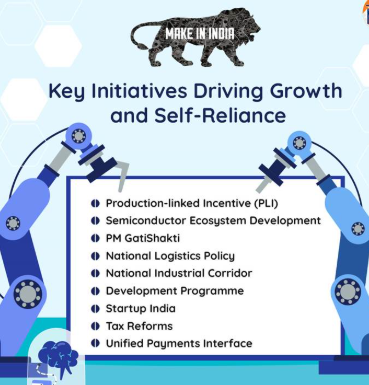
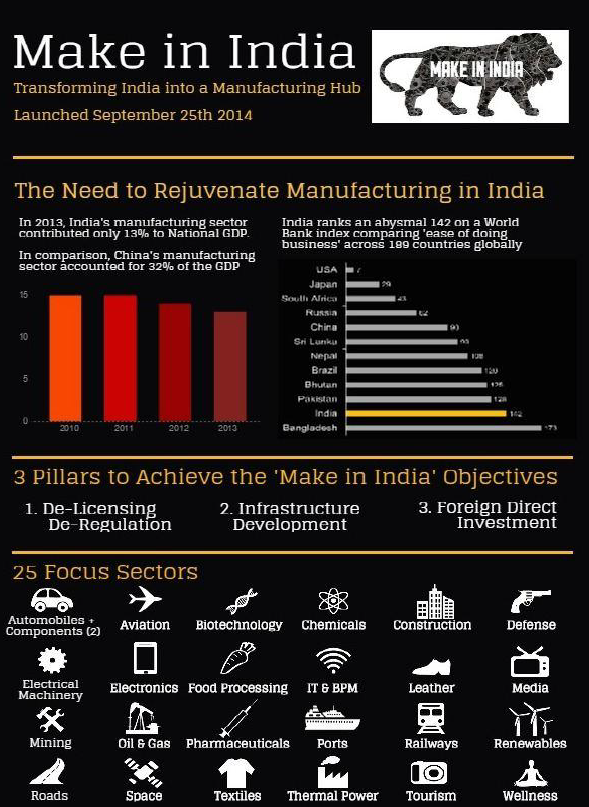
The Make in India programme was introduced to solve many serious economic problems faced by India. One of the biggest challenges was the high level of unemployment, especially among the youth. Every year, millions of young people enter the job market, but the lack of sufficient industries and manufacturing units limited employment opportunities. By promoting manufacturing within the country, Make in India helps create large numbers of jobs in factories, services, transport, construction and other supporting sectors.
Another important need for Make in India was India’s over-dependence on imports. India was importing many products such as electronics, machinery, defence equipment and mobile phones from other countries. This increased the trade deficit and caused a heavy outflow of foreign currency. By encouraging domestic production, the programme reduces imports and saves valuable foreign exchange, which strengthens the national economy.
India also required strong industrial growth to become a major economic power. The service sector alone could not support long-term development. Manufacturing increases productivity, raises income levels and helps in the balanced development of different regions of the country. Through Make in India, the government aims to improve infrastructure, build industrial corridors, develop smart cities and modernise transport systems, which support overall economic growth.
The programme was also needed to attract foreign direct investment (FDI). Global companies bring advanced technology, capital and management skills. This improves production quality and competitiveness of Indian industries. With better business policies and simplified procedures, India has become a more attractive destination for global investors.
Another important reason was the need for self-reliance. A strong nation must be capable of producing its own essential goods, especially in sectors like defence, energy and technology. Make in India promotes the vision of an independent and self-sufficient India that can compete confidently in the global economy.
Thus, the Make in India programme was necessary to strengthen India’s economy, generate employment, promote self-reliance, reduce imports, boost exports and ensure long-term sustainable development.
MAJOR SECTORS COVERED UNDER MAKE IN INDIA
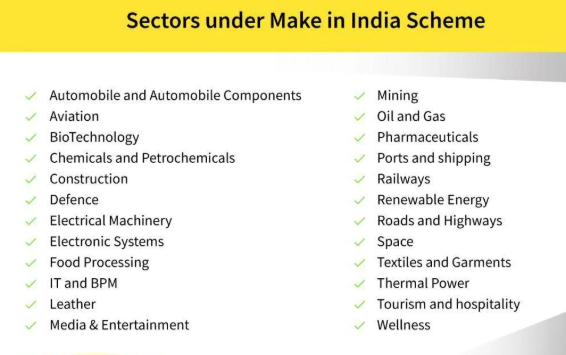
The Make in India programme covers a wide range of important sectors that play a major role in the development of the Indian economy. These sectors were selected to promote industrial growth, generate employment and increase India’s global competitiveness.
One of the key sectors is the automobile sector. This includes the production of cars, two-wheelers, trucks and auto components. The sector provides large-scale employment and supports many small and medium industries.
The electronics sector is another important area. Under Make in India, the government encourages the manufacturing of mobile phones, computers, televisions and other electronic products in India to reduce imports and promote technological development.
The defence manufacturing sector has been given special importance. India aims to produce defence equipment such as weapons, aircraft and naval ships within the country. This strengthens national security and reduces dependence on foreign suppliers.
The textile and garment sector is also a major focus area. It provides employment to millions of people, especially in rural and semi-urban areas. Promotion of this sector helps in increasing exports and improving income levels.
Other important sectors include pharmaceuticals, chemicals, renewable energy, railways, food processing, construction, and information technology. These sectors contribute significantly to industrial growth and economic development.
By developing these major sectors, Make in India supports overall economic progress and helps transform India into a global manufacturing hub.
ROLE OF MAKE IN INDIA IN INDIAN ECONOMY
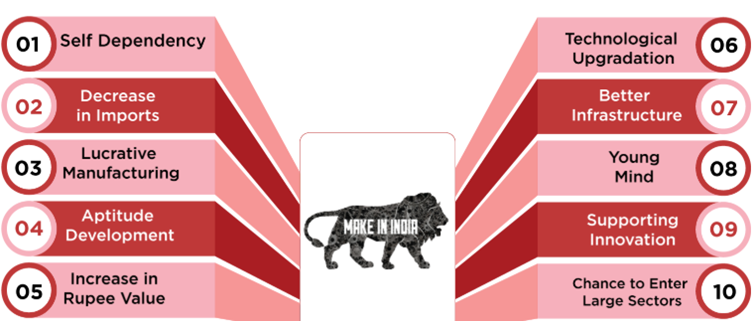
The Make in India programme plays a vital role in strengthening the Indian economy. One of its main contributions is employment generation. As more industries are set up in the country, large numbers of jobs are created in manufacturing, services, transport and supporting sectors. This helps reduce unemployment and improve the standard of living of people.
Make in India also promotes industrial growth. Increased manufacturing activity raises production levels and improves the contribution of the industrial sector to the country’s GDP. This balanced growth between agriculture, industry and services leads to overall economic development.
The programme helps in attracting foreign investment. With improved infrastructure, simplified business rules and better policies, India has become a preferred destination for global investors. Foreign investment brings capital, advanced technology and modern management practices, which enhance productivity and competitiveness of Indian industries.
Another important role is the promotion of exports and reduction of imports. When goods are produced within the country, dependence on foreign products decreases. This improves the balance of trade and strengthens the value of Indian currency.
Make in India also encourages innovation and skill development. Training programmes and skill development initiatives prepare the youth for modern industries, making India’s workforce more productive and efficient.
Thus, Make in India supports sustainable growth, strengthens the economy and helps India move towards self-reliance and global leadership.
ACHIEVEMENTS OF MAKE IN INDIA
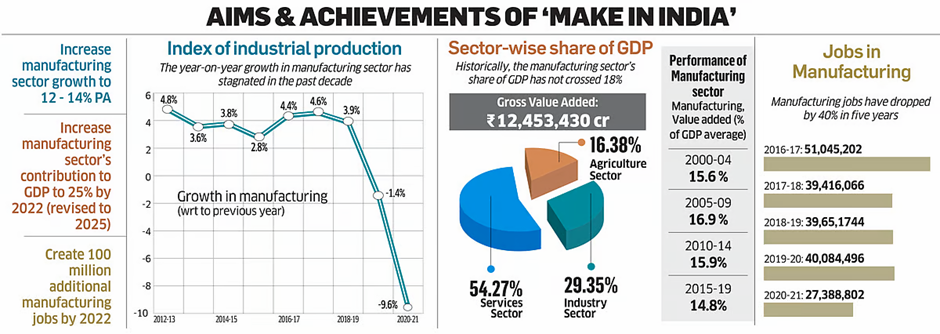
Since its launch, the Make in India programme has brought several positive changes to the Indian economy. One of the major achievements is the increase in manufacturing activity. Many new factories and industrial units have been established across different states, creating employment and boosting production.
Another important achievement is the rise in foreign direct investment (FDI). Many international companies have started or expanded their operations in India, which has brought new technologies, better production methods and higher-quality products.
The programme has also helped in improving infrastructure. Industrial corridors, highways, ports, airports and smart cities have been developed to support industries and improve connectivity.
Make in India has encouraged self-reliance in many sectors such as defence, electronics and renewable energy. Today, India manufactures many products that were earlier imported, which reduces dependence on foreign countries.
Overall, the programme has strengthened India’s industrial base and improved its global image as a manufacturing destination.
CHALLENGES AND LIMITATIONS
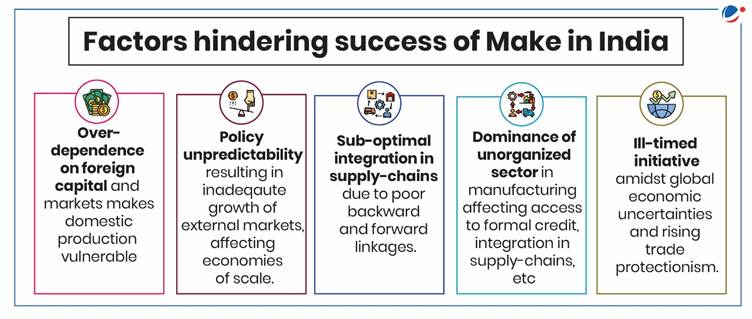
Despite its success, Make in India faces several challenges. One major challenge is the lack of skilled labour in certain industries. Although training programmes are being introduced, there is still a shortage of workers with advanced technical skills.
Another limitation is infrastructure gaps in some regions, such as poor roads, power shortages and slow logistics, which affect industrial efficiency.
Complex regulations, delays in approvals and difficulties in acquiring land also create problems for investors. Small and medium enterprises sometimes struggle to access finance and modern technology.
Global competition and economic uncertainties further affect the growth of manufacturing. Therefore, continuous reforms, better policies and improved coordination are needed to fully achieve the goals of Make in India.
MAKE IN INDIA- A WAY AHEAD (FUTURE SCOPE)
Make in India has laid a strong foundation for India’s economic growth, but its real success lies in how it continues to evolve in the future. The programme must focus on strengthening skill development so that Indian youth are prepared for modern industries and advanced technologies. Continuous training and education will make the workforce more productive and globally competitive.
In the coming years, greater emphasis should be placed on innovation, research and development. Encouraging startups, supporting new ideas and promoting indigenous technology will help India move from being just a manufacturing hub to becoming a global innovation centre.
Improving infrastructure and logistics must remain a top priority. Faster transport, better power supply and digital connectivity will reduce production costs and increase efficiency of industries.
The government should also ensure a more investor-friendly environment by simplifying laws, reducing delays and providing transparent policies. Strong support for small and medium enterprises will further strengthen the industrial ecosystem.
By focusing on sustainability, digital transformation and self-reliance, Make in India can drive long-term growth and help India emerge as a leading global economic power.
CASE STUDY
Make in India and the Mobile Phone Manufacturing Industry
The mobile phone manufacturing industry in India is one of the strongest success stories of the Make in India programme. Before 2014, almost all mobile phones sold in India were imported from countries such as China, South Korea and Vietnam. This caused a huge outflow of foreign currency and made India highly dependent on foreign manufacturers.
After the launch of Make in India, the Government of India introduced special incentives, easier approval processes and improved infrastructure to encourage global companies to set up manufacturing plants in India. As a result, companies like Samsung, Apple, Xiaomi, Oppo, Vivo and Realme established large production units in states such as Uttar Pradesh, Tamil Nadu and Andhra Pradesh.
This shift created millions of direct and indirect jobs. Young people found employment in assembly lines, quality testing, packaging, transportation and marketing. The development of supporting industries such as batteries, chips, packaging materials and software services further strengthened the industrial ecosystem.
India today is one of the largest producers of mobile phones in the world. The country has moved from being an importer to a major exporter of mobile devices. This transformation has reduced the trade deficit, strengthened the Indian rupee and increased government revenue through taxes and exports.
This case study clearly demonstrates how Make in India boosts industrial growth, promotes self-reliance, creates employment and strengthens the economy.
MORAL VALUES LEARNT FROM THE PROJECT
This project has helped develop important moral values that are essential for both personal growth and national development. It highlights the value of self-reliance, teaching that a strong nation must depend on its own skills, resources and capabilities. It encourages respect for Indian products and promotes pride in domestic industries.
The project also teaches the importance of hard work and perseverance. Economic development requires consistent effort, discipline and long-term planning. It promotes the value of cooperation, showing how government, businesses and citizens must work together to achieve national goals.
Another important moral lesson is responsibility towards the nation. Every individual plays a role in strengthening the economy through informed choices, supporting domestic products and contributing to productive work.
CONCLUSION
Make in India is not just a programme; it is a vision for the future of India. It addresses major economic challenges such as unemployment, low industrial growth, trade imbalance and dependence on foreign goods. Through industrial expansion, skill development, technological advancement and infrastructure development, Make in India is building a strong economic foundation for the nation.
Although challenges such as skill gaps, infrastructure limitations and regulatory hurdles remain, continuous reforms and strategic planning will help overcome them. With strong leadership, active participation of citizens and sustained policy support, Make in India can transform India into a global manufacturing and innovation powerhouse.
Thus, Make in India is truly a way ahead for creating a prosperous, self-reliant and globally competitive India.
BIBLIOGRAPHY
- NCERT (2023), Introductory Macroeconomics – Class XII, New Delhi: National Council of Educational Research and Training.
- Government of India (2024), Economic Survey of India, Ministry of Finance, New Delhi.
- NITI Aayog (2024), Manufacturing Sector Development Report, Government of India.
- Reserve Bank of India (2024), Annual Report, RBI Publications, Mumbai.
- The Hindu (2024), Articles on industrial growth and Make in India.
- The Economic Times (2024), Reports on mobile manufacturing in India.