The following is the project work on the topic of Applications of Law of demand in real life. Students can take help of this to prepare their files.
INTRODUCTION
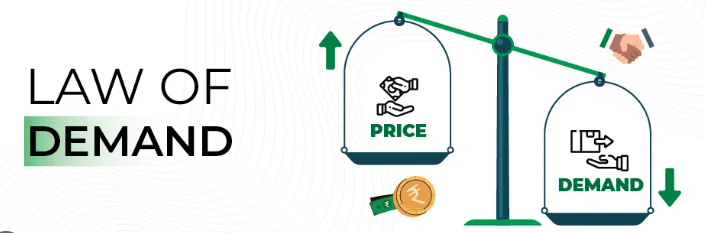
Economics is a subject that helps us understand how people make choices when resources are limited. One of the most important laws in economics is the Law of Demand. This law explains the relationship between the price of a good and the quantity demanded by consumers. According to this law, when the price of a good falls, the demand for it increases, and when the price rises, the demand decreases, assuming other factors remain the same. This principle can be observed in our daily life in markets, shops, businesses and even in government decisions.
The Law of Demand plays a major role in determining prices, production levels and consumer behaviour. Through this project, an attempt has been made to study how this law is applied in real life and how it influences the decisions of consumers, producers and the government.
OBJECTIVES OF THE PROJECT
The main objectives of this project are:
- To understand the meaning and importance of the Law of Demand.
- To study how the Law of Demand operates in real-life situations.
- To analyse the behaviour of consumers in response to price changes.
- To examine the role of the Law of Demand in business and government policies.
- To develop logical thinking and better understanding of economic concepts.
MEANING OF LAW OF DEMAND
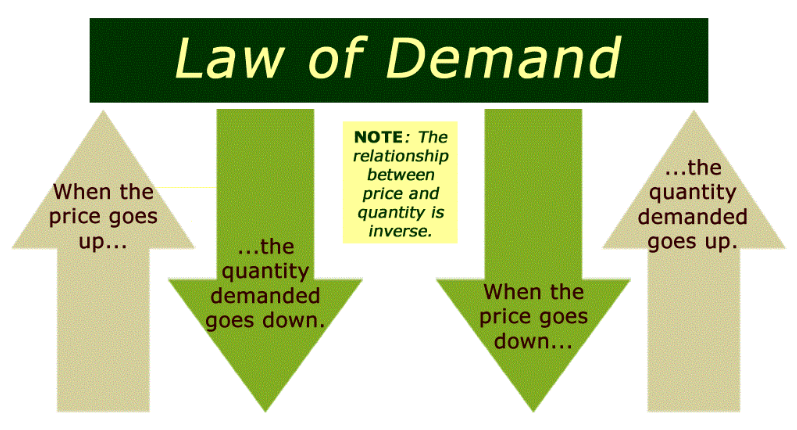
The Law of Demand is one of the fundamental laws of economics. It explains the relationship between the price of a commodity and the quantity demanded by consumers. According to this law, when the price of a commodity decreases, consumers tend to buy more of it. On the other hand, when the price increases, consumers buy less of it. This happens because at a lower price, goods become more affordable and attractive to buyers, while at a higher price, consumers either reduce their consumption or look for cheaper substitutes. The Law of Demand reflects the natural behaviour of consumers and helps in understanding how markets function.
STATEMENT OF LAW OF DEMAND
The Law of Demand states:
“Other things remaining the same, the quantity demanded of a commodity increases when its price falls and decreases when its price rises.”
The phrase “other things remaining the same” refers to constant factors such as income of consumers, tastes and preferences, prices of related goods, and population. This condition is called ceteris paribus. The law shows an inverse relationship between price and quantity demanded and is an essential tool for analysing consumer behaviour in the market.
ASSUMPTIONS OF LAW OF DEMAND
The Law of Demand is based on certain assumptions. These assumptions must remain constant for the law to operate properly.
- There is no change in the income of the consumer.
- The tastes and preferences of consumers remain the same.
- The prices of related goods do not change.
- There is no change in population.
- There is no expectation of future price change.
- The commodity is of normal nature and not a prestige good.
When these conditions remain unchanged, the inverse relationship between price and quantity demanded holds true.
DEMAND SCHEDULE AND DEMAND CURVE
The law of demand can be explained with the following table:
| PRICE OF GOOD X | QUANTITY DEMANDED OF GOOD X |
| 1 2 3 4 5 | 5 4 3 2 1 |
The table shows the negative relationship between the quantity demanded and price. When the price is ₹1, the consumer makes purchase of 5 units. When price rises to ₹5, the quantity demanded decreases to 1 unit.
The law of demand can also be explained with the help of demand curve:
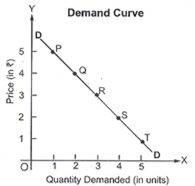
The above curve shows the quantity demanded on OX axis and Price of the commodity on OY axis. DD is the downward sloping curve showing the negative relationship between price and quantity demanded. When the price is ₹1, the consumer makes purchase of 5 units. When price rises to ₹5, the quantity demanded decreases to 1 unit.
FACTORS AFFECTING DEMAND
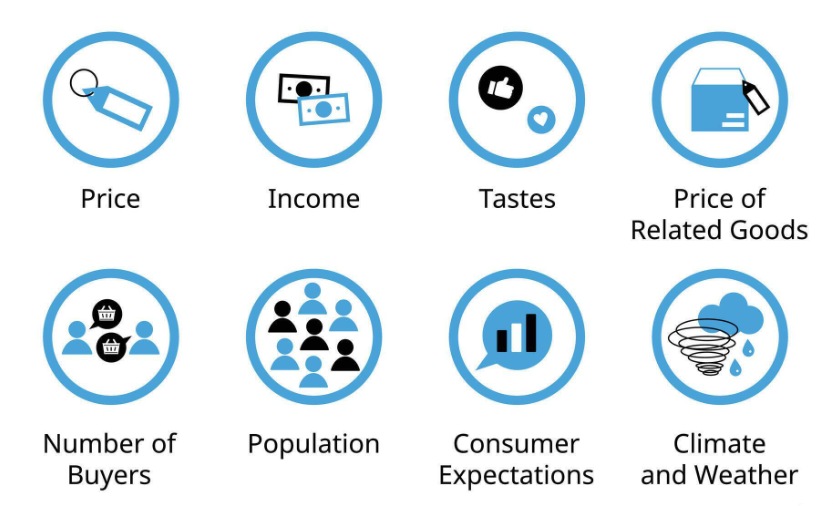
Demand for a commodity does not depend only on its price. There are many other factors that influence the demand for a product. These factors cause the demand to increase or decrease even when the price remains the same.
One of the most important factors is the income of consumers. When the income of people increases, they are able to buy more goods and services, which increases demand. When income decreases, demand also decreases.
Another factor is tastes and preferences of consumers. If a product becomes fashionable or popular, its demand increases. If consumers lose interest in a product, its demand decreases.
Prices of related goods also affect demand. In the case of substitute goods, when the price of one good increases, the demand for its substitute rises. In the case of complementary goods, when the price of one good rises, the demand for the other falls.
Population size influences demand as well. An increase in population leads to higher demand for goods and services, while a decrease in population reduces demand.
Expectations of future prices also affect demand. If consumers expect prices to rise in the future, they may buy more in the present, increasing current demand.
Seasonal changes and climatic conditions can also influence demand, especially for goods like clothes, umbrellas, and air conditioners.
All these factors together determine the level of demand for a product in the market.
APPLICATIONS OF LAW OF DEMAND IN REAL LIFE
Consumer Behavior

The Law of Demand is clearly seen in the behaviour of consumers in daily life. When the price of a product falls, people are encouraged to buy more of it because it becomes affordable. For example, when clothes or shoes are offered at discount during sales, customers purchase more items than usual. On the other hand, when prices increase, people reduce their purchases or shift to cheaper alternatives. This shows that consumers naturally respond to price changes, and their buying decisions follow the Law of Demand.
Business and Pricing Decisions
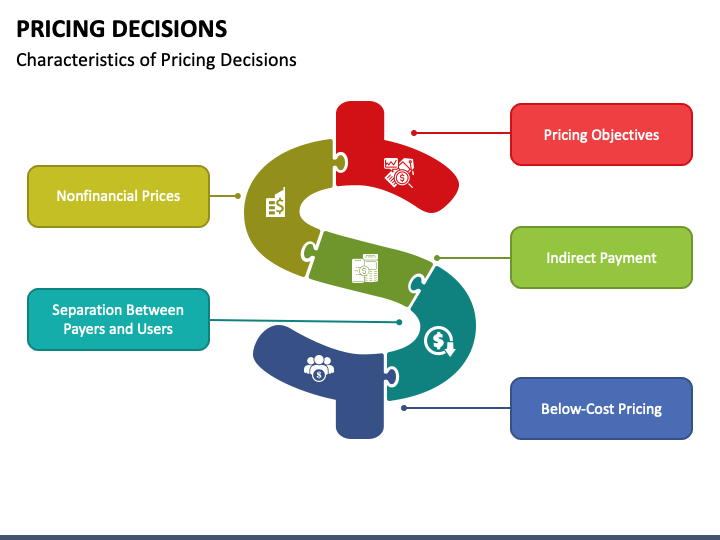
Businesses use the Law of Demand while fixing prices of their products. If the price of a product is too high, demand falls and sales decrease. To increase sales, companies often reduce prices, offer discounts, or introduce special offers. This attracts more customers and increases demand. For example, mobile phone companies lower prices during festive seasons to boost sales. Thus, businesses carefully study consumer demand before making pricing decisions.
Agriculture sector

In the agriculture sector, the Law of Demand helps farmers and traders understand market behaviour. When the price of crops like wheat, rice or vegetables is high, people buy less. When prices fall, demand increases. Farmers often face low prices when production is high, leading to increased demand in the market. Government sometimes sets minimum support prices to protect farmers when demand falls too much. This shows the application of the Law of Demand in agricultural markets.
Stock market

The stock market also follows the Law of Demand. When the price of shares decreases, more investors are willing to buy them because they seem cheaper and more profitable. When share prices rise too much, investors reduce their purchases. Demand and supply of shares together determine their market price. Thus, price changes in the stock market influence investors’ behaviour according to the Law of Demand.
Government Policies and Taxation

The government uses the Law of Demand while making tax policies. When taxes on a product increase, its price rises and demand falls. For example, high taxes on cigarettes reduce their consumption. Similarly, when the government reduces taxes on essential goods, their prices fall and demand increases. In this way, taxation policies are designed keeping in mind the effect of price changes on demand.
CASE STUDY
A clear example of the Law of Demand can be seen in the Indian smartphone market. In recent years, many mobile phone companies such as Samsung, Xiaomi, and Realme have reduced the prices of their smartphones during festive seasons like Diwali and online sales events. These price reductions are often supported by special offers and exchange discounts.

When the prices of smartphones fall, a large number of consumers who were earlier postponing their purchases become willing to buy. As a result, sales increase sharply during these discount periods. On the other hand, when the prices of new models are high at the time of launch, only a limited number of customers are ready to purchase them. After a few months, when prices fall, demand rises again.
This real-life example clearly shows that a decrease in price leads to an increase in quantity demanded, and an increase in price leads to a decrease in demand, which is exactly what the Law of Demand explains.
MORAL VALUES LEARNT FROM PROJECT
This project has helped me understand the importance of making wise and responsible decisions as a consumer. It teaches that people should compare prices and think carefully before buying goods. It also shows the importance of honesty and fairness in business, as correct pricing benefits both buyers and sellers. The project encourages awareness about market conditions and helps develop the habit of making informed choices rather than emotional purchases. It also teaches discipline, patience and the value of planning.
CONCLUSION
The Law of Demand is one of the most important concepts in economics and plays a major role in our daily life. Through this project, it is clear that the Law of Demand influences consumers, businesses, farmers, investors and the government. The relationship between price and demand helps in making better economic decisions. From shopping in markets to formulating government policies, the Law of Demand guides almost every economic activity. Therefore, understanding this law is essential for understanding how the economy functions.
BIBLIOGRAPHY
NCERT (2023), Introductory Microeconomics – Class XII, National Council of Educational Research and Training, New Delhi.
Government of India (2024), Economic Survey of India, Ministry of Finance, New Delhi.
Reserve Bank of India (2024), Annual Report, RBI Publications, Mumbai.
The Economic Times (2024), Articles on consumer markets and pricing trends.
Business Standard (2024), Articles related to demand, pricing strategies and market behaviour.