EXEMPTIONS UNDER GST
Exemptions under GST refers to the release or privileged freedom from some duty or tax. GST also provides exemptions to some parties regarding the registration. There are some people who are exempted from the GST Registration based on what is the nature of their supply.
The taxpayers who are exempted under GST Registration are:
- Agriculturists.
- Persons falling in Threshold Exemption Limit.
- Persons making Nil-Rated/ Exempt supplies of goods and services.
- Persons making Non-Taxable/ Non-GST supplies of goods and services.
- Activities that are neither Supply of Goods nor Services.
- Persons making only supplies covered under reverse charge.
The details of all the parties getting exemptions under GST are as follows:
AGRICULTURISTS
An agriculturist is a person who supplies the products out of his cultivation land. They will be given exemptions from GST Registration. Agro-inputs like fertilizers, seeds, irrigation (electricity is required), machinery and all other agricultural services are also exempted under GST regime.
PERSONS FALLING IN THRESHOLD EXEMPTIONS UNDER GST LIMIT
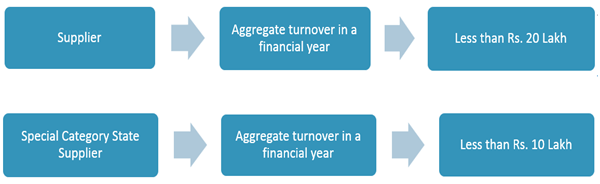
A business entity with an annual turnover less than Rs. 20 lakh is given exemptions from GST registration. But there are some special category states (Arunachal Pradesh, Assam, Jammu and Kashmir, Manipur, Meghalaya, Mizoram, Nagaland, Sikkim, Tripura, Himachal Pradesh and Uttarakhand) where this threshold limit is Rs. 10 lakh.
PERSONS MAKING NIL-RATED/EXEMPT SUPPLIES
These are the persons who are engaged in the business of supplying common items which are in the exemptions under GST. Some of them are mentioned below:
- All unprocessed food like rice, wheat,
bread, milk, vegetables, cereals, eggs, meat, fish, salt etc. - Train travel by local and sleeper classes
- Education
- Healthcare (but not medicines)
- Hotels, lodges with room rent less than Rs 1,000
- Kid’s colouring /drawing books
- Bindis, sindoor, bangles, etc
PERSONS MAKING NON-TAXABLE/ NON-GST SUPPLIES
Such items do not come under the purview or scope of GST:
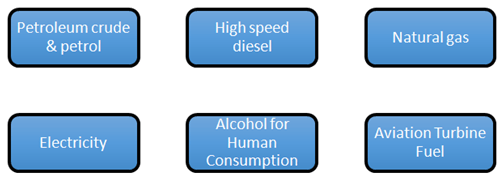
ACTIVITIES THAT ARE NEITHER SUPPLY OF GOODS NOR SERVICES
These include:
- Services by an employee.
- Services by any Court or Tribunal.
- Functions and duties of –
- MPs, MLAs, Members of Panchayats, Municipalities and other local authorities;
- Person holding any Constitutional Post;
- Person as a Chairperson or a Member or a Director in a body.
- Funeral Services.
- Sale of land and building.
- Actionable claims (other than lottery, betting, and gambling).
PERSONS MAKING ONLY SUPPLIES COVERED UNDER REVERSE CHARGE
The Central Government has on 19th June 2016 via Notification No. 5/2017 exempted such persons from obtaining registration who are only engaged in making supplies of taxable goods or services, the total tax on which is liable to be paid on reverse charge basis by the recipient of such goods or services. This notification shall come into force on 22nd June 2016.
QUESTION COVERED
Do you agree that exemptions under GST are given to Goods and Services ? If yes, then state the area of exemptions under GST in brief.
MCQS ON EXEMPTIONS UNDER GST
Q1. Which section of the CGST Act, 2017 deals with the power to grant exemptions under GST?
A. Section 9
B. Section 11
C. Section 16
D. Section 17
Correct Answer: B. Section 11
Explanation: Section 11 of the CGST Act gives the Central Government the power to grant exemption from GST. The exemption can be granted in the public interest on the recommendation of the GST Council through a notification.
Q2. Under GST, an exempt supply includes:
A. Nil-rated supplies only
B. Non-taxable supplies only
C. Nil-rated, wholly exempt and non-taxable supplies
D. Zero-rated supplies only
Correct Answer: C. Nil-rated, wholly exempt and non-taxable supplies
Explanation: According to Section 2(47) of the CGST Act, exempt supply includes:
- Supplies attracting a nil rate of tax.
- Supplies wholly exempt under Section 11.
- Non-taxable supplies.
Remember: Zero-rated supplies are treated separately under GST.
Q3. Which of the following is generally exempt from GST?
A. Restaurant services
B. Healthcare services provided by a clinical establishment
C. Hotel accommodation services
D. Beauty parlour services
Correct Answer: B. Healthcare services provided by a clinical establishment
Explanation: Healthcare services provided by a clinical establishment, authorised medical practitioner or paramedics are generally exempt under the relevant GST exemption notification, subject to specified conditions.
Q4. Which of the following is covered under the definition of exempt supply?
A. Taxable supply
B. Zero-rated supply
C. Non-taxable supply
D. Export of goods
Correct Answer: C. Non-taxable supply
Explanation: Section 2(47) specifically includes non-taxable supplies within exempt supplies. For example, alcoholic liquor for human consumption is outside the levy of GST.
Q5. Who has the power to grant exemption from GST under Section 11 of the CGST Act?
A. State Government alone
B. Central Government
C. GST Council alone
D. Local Authority
Correct Answer: B. Central Government
Explanation: The Central Government can grant exemption on the recommendation of the GST Council. The GST Council recommends exemptions, but the Central Government issues the exemption notification under Section 11.
Q6. Which of the following agricultural activities is generally exempt from GST?
A. Processing of packaged food products
B. Renting agricultural machinery for commercial purposes
C. Cultivation of land by agriculture
D. Manufacturing of fertilisers
Correct Answer: C. Cultivation of land by agriculture
Explanation: Services relating to cultivation of plants and rearing of animals, including cultivation of land by agriculture, are generally exempt. However, certain processing and commercial activities may attract GST.
Q7. Which of the following services is generally exempt under GST?
A. Services by an educational institution to its students
B. Private coaching services
C. Online professional training by private institutes
D. Corporate training services
Correct Answer: A. Services by an educational institution to its students
Explanation: Specified services provided by recognised educational institutions to students, faculty and staff are exempt. Private coaching centres do not automatically qualify for this exemption.
Q8. What is the GST treatment of services provided by an employee to an employer in the course of employment?
A. Taxable at 5%
B. Taxable at 12%
C. Exempt under a notification
D. Neither a supply of goods nor a supply of services
Correct Answer: D. Neither a supply of goods nor a supply of services
Explanation: As per Schedule III of the CGST Act, services provided by an employee to the employer in the course of or in relation to employment are not treated as a supply under GST.
Q9. Which of the following is an example of a nil-rated supply?
A. Supply taxable at 5%
B. Supply taxable at 18%
C. Supply attracting 0% GST under the applicable rate schedule
D. Export of services
Correct Answer: C. Supply attracting 0% GST under the applicable rate schedule
Explanation: Nil-rated supplies are goods or services on which the GST rate is specified as zero under the applicable rate schedule.
Example: Certain fresh and unprocessed food items.
Q10. Which of the following is generally exempt from GST?
A. Renting of commercial buildings
B. Residential renting for use as a residence, subject to applicable conditions
C. Renting of machinery
D. Renting of office premises
Correct Answer: B. Residential renting for use as a residence, subject to applicable conditions
Explanation: Renting a residential dwelling for use as a residence is generally exempt when the applicable conditions are satisfied. However, certain cases, such as renting to a registered person, may attract GST under reverse charge.
Q11. What is the meaning of a non-taxable supply under GST?
A. A supply taxable at 18%
B. A supply that is exempt through a notification
C. A supply not leviable to tax under the CGST or IGST Act
D. A supply taxable at 0.1%
Correct Answer: C. A supply not leviable to tax under the CGST or IGST Act
Explanation: According to Section 2(78) of the CGST Act, a non-taxable supply is a supply of goods or services which is not leviable to tax under the CGST Act or IGST Act.
Example: Alcoholic liquor for human consumption is outside the scope of GST.
Q12. Which of the following is generally exempt from GST?
A. Services by an entity registered under GST
B. Services by an educational institution relating to admission to or conduct of examinations
C. All services provided by private tutors
D. All online educational services
Correct Answer: B. Services by an educational institution relating to admission to or conduct of examinations
Explanation: Specified services provided by educational institutions, including services relating to admission and conduct of examinations, are exempt under GST.
Private coaching centres do not automatically qualify for this exemption.
Q13. If a registered person supplies both taxable and exempt goods, what happens to the input tax credit attributable to exempt supplies?
A. Full ITC is allowed
B. ITC must be reversed proportionately
C. ITC is doubled
D. No reversal is required
Correct Answer: B. ITC must be reversed proportionately
Explanation: According to Section 17(2) of the CGST Act, input tax credit is available only to the extent attributable to taxable supplies, including zero-rated supplies.
ITC attributable to exempt supplies must be reversed.
Example: A business sells taxable furniture and exempt goods. It must reverse the ITC attributable to exempt goods.
Q14. Which of the following is generally exempt from GST?
A. Interest on loans and advances
B. Processing fees charged by banks
C. Credit card late payment charges
D. Bank locker rental charges
Correct Answer: A. Interest on loans and advances
Explanation: Interest on loans, advances and deposits is generally exempt from GST, subject to specified exceptions.
However, processing fees and locker rental charges are generally taxable.
Remember: Interest is generally exempt, but banking service charges are generally taxable.
Q15. Under GST, exemption may be granted through:
A. A notification issued under Section 11
B. A private agreement
C. An oral order by a tax officer
D. A resolution passed by a company
Correct Answer: A. A notification issued under Section 11
Explanation: The Central Government can grant exemption through an official notification under Section 11 of the CGST Act, on the recommendation of the GST Council.
An exemption may be absolute or conditional.
Q16. Which of the following is generally exempt from GST?
A. Sale of old jewellery by a registered jeweller
B. Services of transportation of passengers by metro rail
C. Commercial advertising services
D. Event management services
Correct Answer: B. Services of transportation of passengers by metro rail
Explanation: Passenger transportation services by metro rail are generally exempt under the relevant exemption notification.
Commercial advertising and event management services are generally taxable.
Q17. What is the GST treatment of services provided by a charitable entity?
A. All services are automatically exempt
B. Only services satisfying specified conditions are exempt
C. All services are taxable at 18%
D. All services are taxable at 5%
Correct Answer: B. Only services satisfying specified conditions are exempt
Explanation: Services provided by charitable entities are not automatically exempt.
Specified charitable activities by entities registered under Section 12AA or 12AB of the Income-tax Act are exempt, subject to conditions mentioned in the GST notification.
Q18. Which of the following is generally exempt from GST?
A. Legal services provided by an advocate to a business entity
B. Services by way of public transportation of passengers by a non-air-conditioned stage carriage, subject to conditions
C. Consultancy services
D. Marketing services
Correct Answer: B. Services by way of public transportation of passengers by a non-air-conditioned stage carriage, subject to conditions
Explanation: Passenger transportation by a non-air-conditioned stage carriage is generally exempt under GST, subject to the applicable notification.
Legal services provided by advocates to business entities are generally taxable under the reverse charge mechanism, subject to applicable exemptions.
Q19. What is the impact of exempt supplies on Input Tax Credit (ITC)?
A. ITC is always fully available
B. ITC attributable to exempt supplies is not available
C. ITC is refundable in every case
D. ITC is available without restrictions
Correct Answer: B. ITC attributable to exempt supplies is not available
Explanation: Under Section 17(2), ITC cannot be claimed on inputs and input services attributable to exempt supplies.
If inputs are used for both taxable and exempt supplies, proportionate ITC reversal is required.
Q20. Which of the following statements is correct regarding exempt supplies?
A. Exempt supplies are always zero-rated
B. Exempt supplies include nil-rated supplies and non-taxable supplies
C. Exempt supplies are always taxable at 5%
D. Exempt supplies are only related to services
Correct Answer: B. Exempt supplies include nil-rated supplies and non-taxable supplies
Explanation: Section 2(47) of the CGST Act defines exempt supply. It includes:
- Nil-rated supplies.
- Supplies wholly exempt under Section 11.
- Non-taxable supplies.
Zero-rated supplies, such as exports and supplies to SEZs, are treated separately and are not included in the definition of exempt supply.