DETERMINERS-MEANING
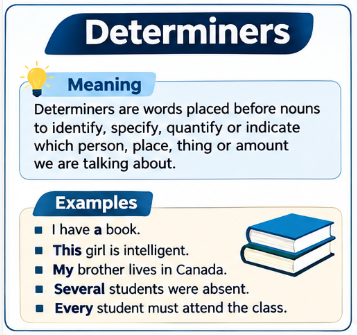
Determiners are words placed before nouns to identify, specify, quantify or indicate which person, place, thing or amount we are talking about. They give additional information about a noun.
Examples:
- I have a book.
- This girl is intelligent.
- My brother lives in Canada.
- Several students were absent.
- Every student must attend the class.
In these examples, the bold words are determiners because they provide information about the nouns.
Basic structure of Determiners

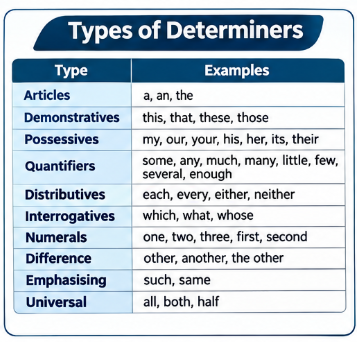
TYPES OF DETERMINERS
| Type | Determiners | Brief description |
| 1. Articles | A, An, The | Identify specific or non-specific nouns. |
| 2. Demonstratives | This, That, These, Those | Point towards particular people or things. |
| 3. Possessives | My, Our, Your, His, Her, Its, Their | Indicate ownership or relationship. |
| 4. Quantifiers | Some, Any, Much, Many, Little, Few, Several, Enough | Express quantity or amount. |
| 5. Distributives | Each, Every, Either, Neither | Refer to individuals or members of a group. |
| 6. Interrogatives | Which, What, Whose | Introduce questions before nouns. |
| 7. Numerals | One, Two, Three, First, Second | Express number or order. |
| 8. Difference determiners | Other, Another, The Other | Indicate additional or remaining persons or things. |
| 9. Emphasising/Similarity | Such, Same | Express a particular kind or identity. |
| 10. Universal determiners | All, Both, Half | Refer to the whole quantity or a complete pair. |
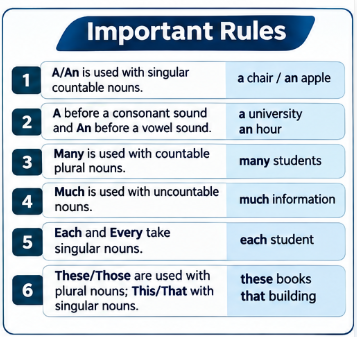
IMPORTANT RULES OF DETERMINERS
| No. | Rule | Example |
| 1 | A/An is used with singular countable nouns. | An umbrella; a chair. |
| 2 | A is used before consonant sounds, not necessarily consonant letters. | A university. |
| 3 | An is used before vowel sounds. | An hour. |
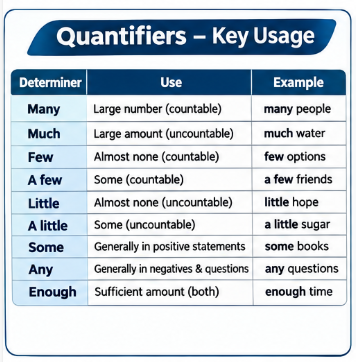
| 4 | Many is used with plural countable nouns. | Many students. |
| 5 | Much is used with uncountable nouns. | Much information. |
| 6 | Few is used with plural countable nouns. | Few candidates. |
| 7 | Little is used with uncountable nouns. | Little knowledge. |
| 8 | Each and every take singular countable nouns. | Each candidate; every student. |
| 9 | Both is used for two people or things. | Both answers are correct. |
| 10 | Either and neither generally refer to two alternatives. | Either option is suitable. |
| 11 | Another is generally followed by a singular countable noun. | Another opportunity. |
| 12 | Other is used with plural countable or uncountable nouns. | Other books; other information. |
| 13 | These and those are followed by plural nouns. | These books. |
| 14 | This and that are followed by singular nouns. | That building. |
| 15 | Enough comes before a noun. | Enough money. |
| 16 | Enough comes after an adjective. | Intelligent enough. |
| 17 | Possessive determiners come before nouns. | Her decision. |
| 18 | No is used before a noun; none is generally a pronoun. | No student came. None came. |
| 19 | All can be used with countable and uncountable nouns. | All students; all the milk. |
| 20 | Fewer is preferred with countable nouns; less with uncountable nouns. | Fewer errors; less time. |
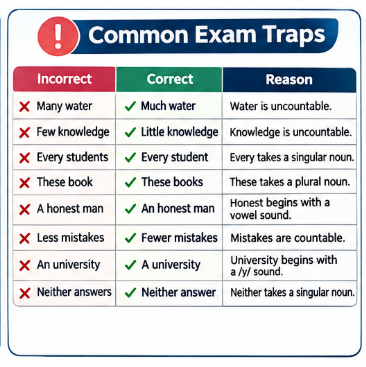
IMPORTANT EXAM TRAPS OF DETERMINERS
These are particularly important for error detection, sentence improvement and fill-in-the-blanks.
| No | Common error | Correct form | Explanation |
| 1 | Many furniture | Much furniture | Furniture is uncountable. |
| 2 | Much people | Many people | People is plural countable. |
| 3 | Few knowledge | Little knowledge | Knowledge is uncountable. |
| 4 | A little students | A few students | Students are countable. |
| 5 | Every candidates | Every candidate | Every takes a singular noun. |
| 6 | Each of the student | Each of the students | Each of + plural noun/pronoun. |
| 7 | These type of questions | These types of questions | Demonstrative agreement. |
| 8 | An one-eyed man | A one-eyed man | One begins with a /w/ sound. |
| 9 | A MBA graduate | An MBA graduate | M begins with a vowel sound. |
| 10 | Another two books | Two other books / Another two books | Both forms can be grammatical, depending on the intended construction. |
| 11 | The both candidates | Both candidates | Do not use the before both in this construction. |
| 12 | Every of them | Every one of them | Correct expression is every one of. |
| 13 | Less mistakes | Fewer mistakes | Mistakes are countable. |
| 14 | Fewer water | Less water | Water is uncountable. |
| 15 | Neither answers | Neither answer | Neither takes a singular noun in standard formal usage. |
| 16 | Such a beautiful flowers | Such beautiful flowers | Such + adjective + plural noun. |
| 17 | My this book | This book of mine | Avoid this determiner combination. |
| 18 | An advice | A piece of advice | Advice is uncountable. |
| 19 | Many a students | Many a student | Many a + singular noun + singular verb. |
| 20 | One of the boy | One of the boys | One of + plural noun. |
ADVANCED EXAM TRAPS- CONFUSING DETERMINERS
| Confusing pair | Difference | Examples |
| Few vs A few | Few = hardly any; A few = some. | Few people agreed. / A few people agreed. |
| Little vs A little | Little = hardly any; A little = some. | Little hope remained. / A little hope remained. |
| The few vs Few | The few = all of a small number. | The few friends I have are loyal. |
| The little vs Little | The little = the entire small amount. | The little money I had was spent. |
| Some vs Any | Some generally occurs in affirmative statements; any in negatives and questions. | I have some books. / I have not any books. |
| Each vs Every | Each focuses on individuals; every considers all members. | Each player received a medal. |
| Either vs Neither | Either = one of two; neither = not one or the other. | Either road is fine. / Neither road is safe. |
| Another vs Other | Another = one more/different; other = additional/different. | Another chance; other chances. |
| All vs Whole | All generally refers to total quantity; whole refers to something complete. | All the students; the whole day. |
| Less vs Fewer | Less = uncountable; fewer = countable plural. | Less sugar; fewer apples. |
| Both vs All | Both = two; all = entire group or quantity. | Both brothers; all brothers. |
| No vs None | No comes before a noun; none generally stands independently. | No student came. None came. |
DIFFICULT FAQS- COMPETITIVE EXAMINATION LEVEL
Q1. Can ‘Many a’ be followed by a plural noun?
No. Many a is followed by a singular countable noun and takes a singular verb.
- Correct: Many a student has failed.
- Incorrect: Many a students have failed.
Q2. Can ‘Each’ be used with ‘of’?
Yes. Each of is followed by a plural noun or pronoun, but normally takes a singular verb.
- Each of the candidates is qualified.
- Each of them has submitted the form.
Q3. What is the difference between ‘Every one’ and ‘Everyone’?
| Every one | Everyone |
| Can be used for people and things. | Refers to people. |
| Every one of the books is useful. | Everyone is invited. |
| Usually followed by ‘of’ when specifying a group. | Does not take ‘of’ directly. |
Q4. Can ‘Both’ be used with ‘and’?
Yes. Both…and is a correlative construction.
Example: Both Priya and Kajal are intelligent.
Q5. Can ‘Either’ and ‘Neither’ be used for more than two options?
In traditional examination grammar, either and neither are generally associated with two choices. When referring to more than two, any and none are usually preferred.
Q6. What is the difference between ‘Another’ and ‘The other’?
- Another: One additional or different item.
- The other: The remaining item when referring to two.
Example: I have two pens. One is blue, and the other is black.
Q7. Can ‘Much’ be used in affirmative sentences?
Yes. Much is possible in affirmative sentences, especially with too, so, as, how and very.
Examples:
- There is too much noise.
- She has so much patience.
- I have very much respect for her.
Q8. Is ‘Information’ countable or uncountable?
Information is uncountable.
- Correct: Some information.
- Incorrect: An information.
- Correct: A piece of information.
Q9. Can ‘All’ be used before a singular noun?
Yes, with an appropriate uncountable noun.
Example: All the information was useful.
Q10. What is the difference between ‘All’ and ‘All of’?
Both are possible, but their constructions differ.
- All students passed.
- All of the students passed.
- All of them passed.
Before a noun with a determiner such as the, my or these, both all and all of can be used.
Q11. Can ‘Enough’ be placed after a noun?
Usually, enough comes before a noun.
- Enough food.
- Enough opportunities.
But it follows adjectives and adverbs.
- Strong enough.
- Quickly enough.
Q12. Is ‘A number of’ singular or plural?
A number of + plural noun generally takes a plural verb.
Example: A number of students are absent.
Compare:
The number of students is increasing.
Q13. Can ‘Such’ be used with singular countable nouns?
Yes. Such a/an + adjective + singular countable noun.
Example: She is such an intelligent girl.
Q14. What is the difference between ‘A little’ and ‘The little’?
- A little: Some amount.
- The little: The entire small amount available.
Examples:
- I have a little time.
- The little time I had was wasted.
Q15. Can ‘Both’ be followed by ‘of’?
Yes.
- Both students passed.
- Both of the students passed.
- Both of them passed.
SPECIAL STRUCTURES TO MEMORISE
| Structure | Example |
| Many a + singular noun + singular verb | Many a soldier has sacrificed his life. |
| Each of + plural noun + singular verb | Each of the girls is talented. |
| Every one of + plural noun + singular verb | Every one of the players is ready. |
| A number of + plural noun + plural verb | A number of students are waiting. |
| The number of + plural noun + singular verb | The number of students is rising. |
| Both A and B + plural verb | Both Ram and Shyam are present. |
| Either A or B | Either Ram or Shyam is responsible. |
| Neither A nor B | Neither Ram nor Shyam is responsible. |
| Such + a/an + adjective + singular noun | Such a beautiful place! |
| Such + adjective + plural noun | Such beautiful flowers! |
| Quite + a/an + adjective + singular noun | Quite an interesting book. |
| Rather + a/an + adjective + singular noun | Rather a difficult question. |
| Half + the/a + noun | Half the population voted. |
| All + the/my/these + noun | All the students are present. |
Advanced subject-verb agreement tip: In either…or and neither…nor constructions, the verb generally agrees with the subject nearest to it.
- Neither the teacher nor the students are ready.
- Neither the students nor the teacher is ready.
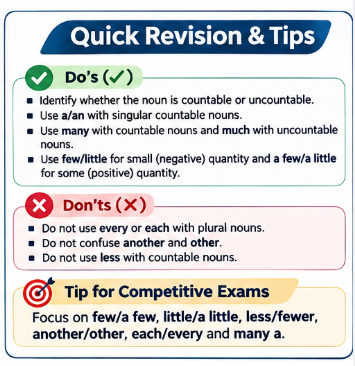
TOP TIPS FOR COMPETITIVE EXAMS REGARDING USE OF DETERMINERS
1. Identify the noun first: Determine whether it is singular, plural, countable or uncountable.
2. Check the verb: Each, every, neither and either generally take singular verbs in standard examination constructions.
3. Remember sound, not spelling: A university, an hour, an MBA.
4. Learn confusing pairs together: Few/a few, little/a little, another/other, less/fewer.
5. Watch for uncountable nouns: Advice, information, furniture, luggage, equipment, knowledge, research and stationery.
6. Understand quantity and quality: Few and little express an insufficient amount; a few and a little express a small but positive amount.
7. Do not confuse determiners and pronouns: My is a determiner; mine is a pronoun. Some can function as either, depending on its use.
8. Look for unnecessary articles: Avoid constructions such as the my book, the both boys and an information.
9. Remember fixed expressions: Many a student, a number of students, the number of students.
10. Read the entire sentence: The correct determiner depends on meaning, not just the noun immediately following it.
LAST-MINUTE REVISION: 15 GOLDEN RULES
| No. | Remember |
| 1 | Many + plural countable noun |
| 2 | Much + uncountable noun |
| 3 | Few + plural countable noun |
| 4 | Little + uncountable noun |
| 5 | A few = some |
| 6 | A little = some |
| 7 | Each + singular noun |
| 8 | Every + singular noun |
| 9 | Both + plural noun |
| 10 | Either + singular noun |
| 11 | Neither + singular noun |
| 12 | Another + singular countable noun (standard basic pattern) |
| 13 | Other + plural countable/uncountable noun |
| 14 | Fewer + countable; less + uncountable |
| 15 | Enough + noun; adjective + enough |
Exam preparation tip: Pay special attention to many a, each of, every one of, a number of, the number of, few/a few, little/a little, and another/other. These structures are especially useful for mastering advanced determiner questions in error spotting and sentence improvement.