DETERMINERS: ARTICLES (A, AN, THE)
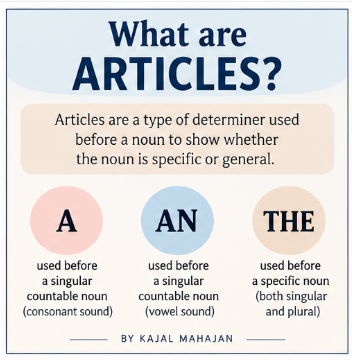
Articles are a type of determiner used before nouns to indicate whether we are referring to something in a general, non-specific way or to something specific. There are three articles in English: A, AN and THE.
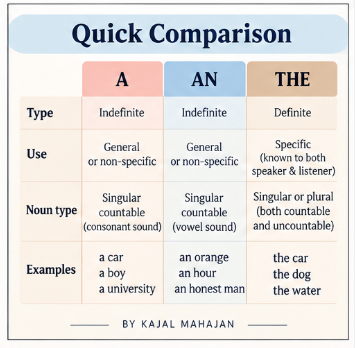
| Article | Type | Main Use | Example |
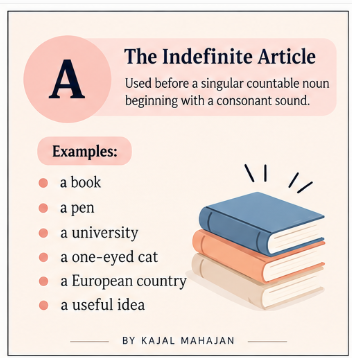
| A | Indefinite article | Before a singular countable noun beginning with a consonant sound | I saw a dog. |
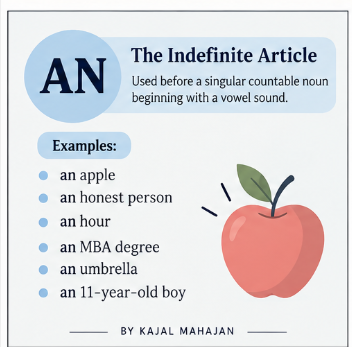
| An | Indefinite article | Before a singular countable noun beginning with a vowel sound | She ate an apple. |
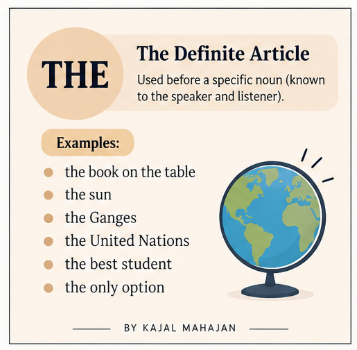
| The | Definite article | Before a specific or identified noun | The dog in my garden is friendly. |
Rules of A and AN
The choice between a and an depends on the first sound of the next word, not merely its first letter.
| Rule / Situation | Use A | Use AN |
| Consonant sound | a boy, a cat, a pen | — |
| Vowel sound | — | an orange, an umbrella |
| Words beginning with a silent h | — | an hour, an honest man, an heir |
| Words beginning with a pronounced h | a house, a horse, a hotel | — |
| Words beginning with a vowel letter but pronounced with a consonant sound /y/ | a university, a European, a useful book | — |
| Abbreviations beginning with a consonant letter but a vowel sound | — | an MBA, an FIR, an MLA |
| Abbreviations beginning with a vowel letter but a consonant sound | a USB drive, a U-turn | — |
| Singular countable nouns mentioned for the first time | a teacher, a student | an engineer, an artist |
| Occupations | He is a doctor. | She is an architect. |
EXAM TRAPS: A vs AN
| Incorrect | Correct | Reason |
| an university | a university | Begins with the /y/ sound. |
| a honest man | an honest man | The h is silent. |
| an European country | a European country | Begins with the /y/ sound. |
| a hour | an hour | The h is silent. |
| an one-eyed man | a one-eyed man | One begins with a /w/ sound. |
| a MBA graduate | an MBA graduate | “M” is pronounced em. |
| an useful book | a useful book | Useful begins with the /y/ sound. |
| a FIR | an FIR | “F” is pronounced ef. |
Rules of THE
| Rule / Situation | Usage of THE | Example |
| A particular person or thing | Used when the noun is identified | Please close the door. |
| Second mention of a noun | Used when something has already been introduced | I saw a cat. The cat was black. |
| Unique things | Used for things considered unique in context | The Sun, the Moon, the Earth |
| Superlative degree | Used before superlative adjectives | She is the tallest girl in the class. |
| Ordinal numbers | Used before ordinal numbers | He won the first prize. |
| Rivers, seas and oceans | Generally used with these geographical names | The Ganga, the Arabian Sea, the Pacific Ocean |
| Mountain ranges | Used with mountain ranges | The Himalayas, the Alps |
| Groups of islands | Used with groups of islands | The Andaman and Nicobar Islands |
| Deserts | Generally used with desert names | The Sahara Desert, the Thar Desert |
| Newspapers | Generally used with newspaper names | The Hindu, The Times of India |
| Musical instruments | Used when referring to playing an instrument in the conventional sense | She plays the piano. |
| A whole class of people | Used with an adjective representing a group | The rich should help the poor. |
| Directions | Used for named geographical directions | The North, the South |
| Certain historical buildings and monuments | Used with established names | The Red Fort, the Taj Mahal |
| Nationalities referring to a whole people | Used with certain nationality adjectives | The French, the British |
A / AN vs THE
| Basis | A / AN | THE |
| Meaning | Non-specific or one among many | Specific or identified |
| First mention | Commonly used | Possible when the noun is already identifiable or unique |
| Second mention | Usually not used again for the same identified noun | Commonly used |
| Countable nouns | Used with singular countable nouns | Used with singular, plural and uncountable nouns |
| Example: singular | I bought a book. | The book is interesting. |
| Example: plural | Not used directly before plural nouns | The books on the shelf are mine. |
| Example: uncountable | Not used directly before uncountable nouns | The water in this bottle is cold. |
Remember: A/an cannot normally be used directly before plural countable nouns or uncountable nouns.
- Incorrect: a books
- Correct: books / the books
- Incorrect: an information
- Correct: some information / a piece of information
ZERO ARTICLE- When NO Article Is Used
One of the most important examination areas is knowing when to use no article at all.
| Situation | Rule | Example |
| Names of people | Generally no article | Kajal is a teacher. |
| Names of cities and countries | Generally no article | India is a large country. |
| Languages | No article when referring to languages generally | She speaks English. |
| School subjects | No article when referring to subjects generally | Economics is interesting. |
| Meals | No article when referring to meals generally | We had breakfast at eight. |
| Sports and games | No article | He plays cricket. |
| Days and months | No article | Monday is a holiday. |
| Abstract nouns used generally | No article | Honesty is the best policy. |
| Uncountable nouns used generally | No article | Water is essential for life. |
| Plural countable nouns used generally | No article | Dogs are loyal animals. |
| Most individual mountains and lakes | No article | Mount Everest, Lake Victoria |
| Institutions used for their primary purpose | Often no article in standard expressions | She goes to school. He is in prison. |
EXAM TRAPS: ARTICLES
| No. | Common Exam Question | Correct Answer | Explanation |
| 1 | He is ___ European. | a | European begins with a /y/ sound. |
| 2 | She is ___ M.A. student. | an | “M” is pronounced em. |
| 3 | ___ Ganga is a sacred river. | The | Rivers generally take the. |
| 4 | Honesty is ___ best policy. | the | Superlative expression: the best. |
| 5 | I go to ___ school every day. | No article | Refers to attending school for its primary purpose. |
| 6 | I visited ___ school near my house. | the / a | Use the if identified; a if being introduced as one of many. |
| 7 | She plays ___ violin. | the | Conventional reference to playing a musical instrument. |
| 8 | He had ___ breakfast at 8 a.m. | No article | Meals generally take no article. |
| 9 | ___ rich should help the poor. | The | Adjective represents a whole class of people. |
| 10 | I need ___ information about the course. | No article | Information is uncountable. |
| 11 | He is ___ honest officer. | an | Silent h. |
| 12 | This is ___ unique opportunity. | a | Unique begins with a /y/ sound. |
| 13 | She is ___ tallest girl in the class. | the | Superlative adjective. |
| 14 | We climbed ___ Mount Everest. | No article | Most individual mountain names take no article. |
| 15 | I saw a dog. ___ dog was barking. | The | The noun has already been introduced. |
QUICK REVISION OF THE MOST IMPORTANT RULES
| Remember This | Rule |
| Sound, not spelling | Choose a/an according to pronunciation. |
| Singular countable noun | Usually requires a determiner: a book, the book, my book. |
| First mention vs second mention | Usually a/an first, then the when identified. |
| Superlatives | Usually use the: the best, the most beautiful. |
| Unique things | Use the when treated as unique: the Sun, the Moon. |
| General plural nouns | No article: Birds fly. |
| General uncountable nouns | No article: Milk is nutritious. |
| Specific plural or uncountable nouns | Use the when identified: the birds in this tree; the milk in the glass. |
| Geographical names | Rivers and oceans generally take the; individual mountains and most countries do not. |
| Fixed expressions | Learn common expressions such as go to school, have breakfast, and play the piano. |