SOURCES OF RURAL FINANCE
Rural finance means providing loans and financial services to farmers, rural workers, small businesses, and people living in villages. It helps them meet agricultural expenses and improve their standard of living.
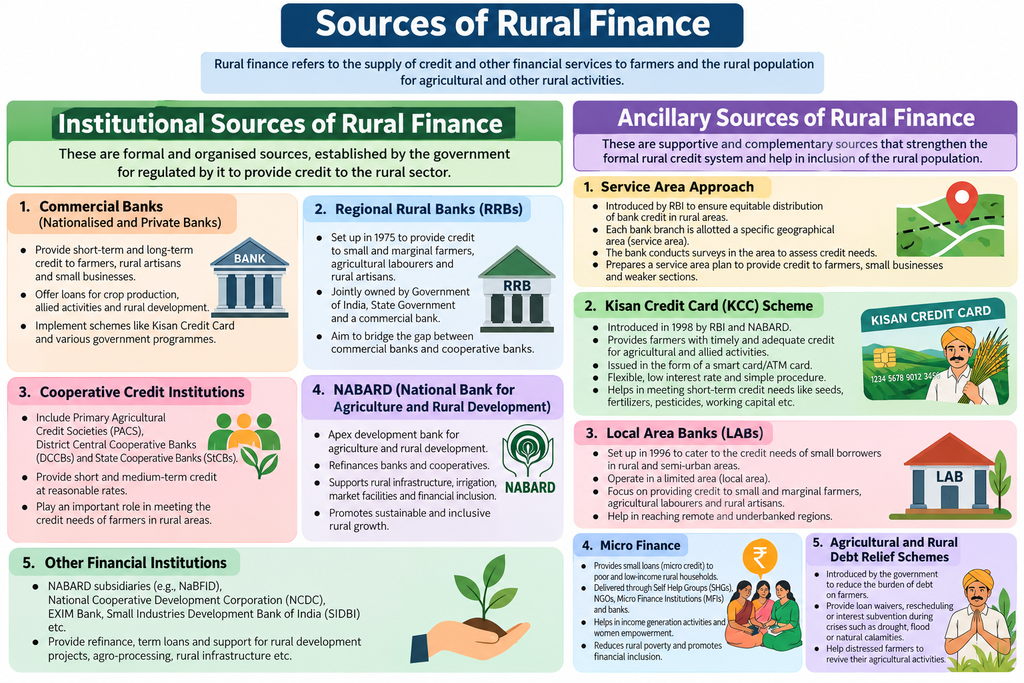
Institutional Sources of Rural Finance
Institutional sources are formal and organised financial institutions that provide loans to farmers and rural people. These institutions work under established rules and help people obtain credit for productive activities.
1. Commercial Banks
Commercial banks provide loans to farmers for purchasing seeds, fertilisers, tractors, machinery, and other agricultural requirements. They also provide loans to rural businesses for starting or expanding their activities.
2. Regional Rural Banks (RRBs)
Regional Rural Banks were established in 1975 to provide banking facilities to rural people. They mainly support small and marginal farmers, agricultural labourers, rural artisans, and weaker sections of society.
3. Cooperative Credit Institutions
Cooperative credit institutions provide loans to farmers at reasonable rates to meet their agricultural needs. They work on the principle of cooperation and help farmers obtain credit without depending heavily on moneylenders.
Sub-sources of cooperative credit institutions:
- Primary Agricultural Credit Societies (PACS): These societies work at the village level and provide short-term loans to farmers for seeds, fertilisers, and other farming expenses.
- District Central Cooperative Banks (DCCBs): These banks operate at the district level and provide financial support to PACS and other cooperative institutions.
- State Cooperative Banks (StCBs): These banks operate at the state level and provide funds and guidance to district cooperative banks.
4. NABARD
NABARD stands for the National Bank for Agriculture and Rural Development. It supports agricultural and rural development by providing refinance to eligible financial institutions, promoting rural infrastructure, and strengthening the rural credit system.
5. Other Financial Institutions
Other financial institutions also support rural development by providing finance for small industries, rural businesses, and infrastructure projects. They help create employment opportunities and improve economic activities in rural areas.
Examples:
- SIDBI: Supports micro, small, and medium enterprises (MSMEs), including eligible enterprises operating in rural areas.
- NCDC: Supports eligible cooperative organisations and their development projects.
- EXIM Bank: Supports India’s international trade, including eligible export-related businesses.
Ancillary Sources of Rural Finance
These are special banking arrangements, credit schemes, and financial services that help farmers and rural households obtain credit more easily. They also promote financial inclusion and provide support to eligible borrowers.
1. Service Area Approach (SAA)
The Service Area Approach was introduced by the RBI in 1989 to improve the availability of bank credit in rural areas. Under this approach, bank branches were assigned specific villages or areas to assess their credit needs and prepare plans to provide loans.
2. Kisan Credit Card (KCC) Scheme
The Kisan Credit Card Scheme was introduced in 1998 to provide timely and convenient credit to farmers. It helps farmers meet expenses on seeds, fertilisers, pesticides, and other eligible agricultural activities without repeatedly applying for a separate loan.
3. Local Area Banks (LABs)
Local Area Banks were introduced in India in 1996 to provide banking services within a limited geographical area. They collect savings from local people and provide loans to farmers, small businesses, and other rural borrowers.
4. Microfinance
Microfinance provides small loans and other financial services to low-income households that may have limited access to traditional banking. It helps rural people, especially women and small entrepreneurs, start small businesses, earn income, and become financially independent.
Sub-sources or channels of microfinance:
- Self-Help Groups (SHGs): Small groups of people who save money regularly and provide loans to their members from their pooled savings.
- Microfinance Institutions (MFIs): Organisations that provide small loans and other financial services to low-income individuals and groups.
- SHG–Bank Linkage Programme: A programme that connects Self-Help Groups with banks so that eligible groups can access bank credit.
5. Agricultural and Rural Debt-Relief Schemes
These schemes or measures aim to reduce the repayment burden of eligible farmers and rural borrowers facing financial difficulties. Depending on the scheme, relief may include loan waivers, rescheduling of repayments, or other forms of assistance.
Sub-types of debt relief:
- Loan Waiver: Under a qualifying scheme, the repayment of specified loans may be waived for eligible borrowers.
- Loan Rescheduling: The repayment period or instalments are changed to give eligible borrowers more time to repay.
- Interest Relief: Eligible borrowers receive a reduction or subsidy on interest under the conditions of a particular scheme.
MCQs on Sources of Rural Finance
Q1. Which of the following is an institutional sources of rural finance?
- A. Moneylenders
- B. Traders
- C. Commercial banks
- D. Landlords
Q2. NABARD stands for:
- A. National Bank for Agriculture and Rural Development
- B. National Association for Banking and Agricultural Research Development
- C. National Board for Agricultural and Regional Development
- D. National Bank for Agricultural Revenue and Development
Q3. The main objective of Regional Rural Banks (RRBs) is to:
- A. Provide loans only to large industries
- B. Provide banking facilities to rural people
- C. Finance foreign trade only
- D. Provide loans only to urban businesses
Q4. Which of the following is a cooperative credit institution at the village level?
- A. NABARD
- B. Commercial bank
- C. Primary Agricultural Credit Society (PACS)
- D. EXIM Bank
Q5. The Kisan Credit Card (KCC) Scheme was introduced in:
- A. 1989
- B. 1991
- C. 1996
- D. 1998
Q6. The main purpose of the Kisan Credit Card Scheme is to:
- A. Provide free agricultural machinery
- B. Provide timely credit to farmers
- C. Provide free land to farmers
- D. Provide employment only in cities
Q7. The Service Area Approach was introduced to:
- A. Improve the distribution of bank credit in rural areas
- B. Increase imports of agricultural goods
- C. Promote urban industries only
- D. Reduce agricultural production
Q8. Local Area Banks mainly operate:
- A. Throughout the world
- B. Only in metropolitan cities
- C. Within a limited geographical area
- D. Only in foreign countries
Q9. Which of the following is a feature of microfinance?
- A. It provides loans only to large companies
- B. It provides small loans to low-income households
- C. It finances only government departments
- D. It provides loans only for international trade
Q10. Self-Help Groups (SHGs) generally encourage members to:
- A. Save regularly and provide loans to members
- B. Stop saving money
- C. Depend only on moneylenders
- D. Avoid all banking services
Q11. Which institution supports agricultural and rural development by providing refinance to eligible financial institutions?
- A. SEBI
- B. NABARD
- C. Election Commission
- D. UPSC
Q12. Which of the following is an informal source of rural finance?
- A. Regional Rural Bank
- B. Cooperative bank
- C. Commercial bank
- D. Moneylender
Q13. A farmer needs money to purchase seeds and fertilisers for the next crop. Which of the following sources of rural finance would be most suitable for timely agricultural credit?
- A. Kisan Credit Card
- B. Foreign trade loan
- C. Housing loan only
- D. Education loan only
Q14. Which of the following is the correct sequence of cooperative credit institutions from village level to state level?
- A. State Cooperative Bank → PACS → DCCB
- B. PACS → DCCB → State Cooperative Bank
- C. DCCB → State Cooperative Bank → PACS
- D. PACS → State Cooperative Bank → DCCB
Q15. The Service Area Approach assigned specific villages or areas to bank branches mainly to:
- A. Assess local credit needs and plan lending
- B. Stop lending to farmers
- C. Promote only foreign investments
- D. Reduce the number of rural borrowers
Q16. A group of rural women saves a small amount every month and gives loans to members when needed. This is an example of:
- A. Commercial banking only
- B. Self-Help Group
- C. Local Area Bank
- D. Stock exchange
Q17. Which of the following best describes agricultural and rural debt-relief schemes?
- A. Schemes that increase the burden of debt
- B. Schemes that provide relief to eligible borrowers facing repayment difficulties
- C. Schemes that provide loans only to large companies
- D. Schemes that prohibit all agricultural loans
Q18. A small entrepreneur in a village needs a small loan to start a tailoring business. Which financial service may be most helpful?
- A. Microfinance
- B. Foreign exchange trading
- C. Large industrial finance only
- D. International trade finance only
Q19. Which statement about Local Area Banks is correct?
- A. They operate only outside India
- B. They mainly finance international organisations
- C. They provide banking services within a limited geographical area
- D. They do not accept local savings
Q20. Which of the following correctly matches the source with its function?
- A. NABARD — Conducts elections
- B. KCC — Provides timely agricultural credit
- C. Microfinance — Finances only large multinational companies
- D. PACS — Regulates the stock market
ANSWER KEY
1. C
Commercial banks are formal institutional sources of rural finance.
2. A
NABARD means National Bank for Agriculture and Rural Development.
3. B
RRBs provide banking and credit facilities to rural communities, including small farmers.
4. C
PACS operate at the village level and provide credit to their members.
5. D
The Kisan Credit Card Scheme was introduced in 1998.
6. B
KCC helps farmers obtain timely credit for eligible agricultural expenses.
7. A
The Service Area Approach aimed to improve planned bank lending in rural areas.
8. C
Local Area Banks operate within a limited geographical area.
9. B
Microfinance offers small loans and other financial services to low-income households.
10. A
SHGs promote regular savings and lending among their members.
11. B
NABARD supports rural credit and development, including refinance to eligible institutions.
12. D
Moneylenders are informal lenders, unlike regulated banks.
13. A
KCC is designed to help farmers meet eligible agricultural credit needs.
14. B
The usual cooperative credit structure runs from PACS to DCCBs to State Cooperative Banks.
15. A
Banks assessed the credit needs of their assigned areas and planned lending accordingly.
16. B
An SHG is a group whose members save together and may lend from pooled funds.
17. B
Debt-relief measures may ease repayment burdens for eligible borrowers under specific scheme rules.
18. A
Microfinance can help small entrepreneurs obtain modest amounts of credit.
19. C
Local Area Banks serve customers within a limited geographical area.
20. B
KCC helps farmers access timely credit for agricultural and related eligible needs.