AMANDA- PREVIOUS YEAR QUESTIONS AND COMPETENCY BASED QUESTIONS
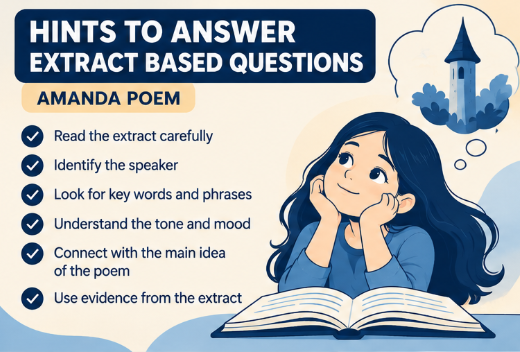
Read the following extract, and answer the questions that follow.
Don’t eat that chocolate, Amanda!
Remember your acne, Amanda!
Will you please look at me when I’m speaking to you, Amanda!
(I am Rapunzel, I have not a care;
Life in a tower is tranquil and rare;)
[CBSE 2024]
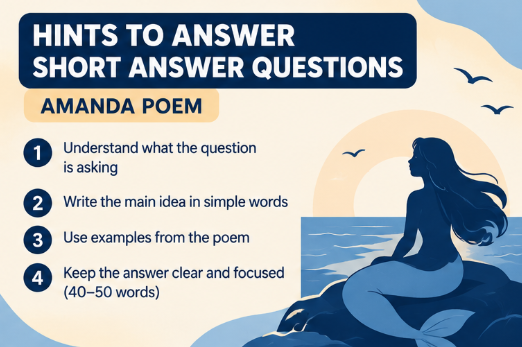
Q1. What is the central idea of the poem as reflected in the lines above? Answer in about 40 words.
Answer: The central idea in the lines above reflects Amanda’s desire to escape from the adult’s constant instructions and control. While being scolded about her behaviour, Amanda imagines herself as Rapunzel. She visualises living peacefully and freely, away from any interference or restrictions.
Don’t eat that chocolate, Amanda!
Remember your acne, Amanda!
Will you please look at me when I’m speaking to you, Amanda!
(I am Rapunzel, I have not a care;
Life in a tower is tranquil and rare;)
[CBSE 2024]
Q2. Identify any one poetic device used in the above extract.
Ans: One poetic device used in the above extract is allusion. The reference to Rapunzel, without any context or further explanation, is an allusion to the well-known fairy tale character who was locked in a tower.
Don’t eat that chocolate, Amanda!
Remember your acne, Amanda!
Will you please look at me when I’m speaking to you, Amanda!
(I am Rapunzel, I have not a care;
Life in a tower is tranquil and rare;)
[CBSE 2024]
Q3. For what reason does Amanda imagine herself to be Rapunzel?
Ans: Amanda imagines herself to be Rapunzel because she wants to escape from the constant instructions and criticism from the adult. Rapunzel, living alone in a peaceful tower, represents the freedom and solitude Amanda desires.
Q4. Complete the following with the impact on the reader. [AQP 2024 (Modified)]
The lack of the special use of parentheses for the lines with Amanda’s thoughts would have resulted in ______.
Ans: The lack of the special use of parentheses for the lines with Amanda’s thoughts would have resulted in confusion between Amanda’s reality and her imagination, making it harder for the reader to distinguish between the adult’s instructions and Amanda’s inner world.
Q5. Explain why Amanda wants to be an orphan. Refer to the given lines, from the text – I am an orphan, roaming the street. I pattern soft dust with my hushed, bare feet. The silence is golden, the freedom is sweet. [CBSE 2024]
OR
“I am an orphan, roaming the street.” Why does Amanda visualise this? [CBSE 2022]
Ans: Amanda wants to be an orphan because she imagines orphans as being free from adult control and rules. In her imagination, being an orphan means she can walk quietly and freely without anyone telling her what to do. She sees this freedom as peaceful and pleasant, unlike her real life filled with constant instructions and scolding.
Q6. How does the line, “I thought I told you to clean your shoes, Amanda!” help us infer that Amanda’s actions are being closely monitored and directed. [AQP 2024]
Ans: The line shows that Amanda’s actions are being closely monitored because the adult is not only aware of whether small tasks like cleaning her shoes have been done, but also expects her to follow every instruction. This level of attention suggests strict control and supervision over Amanda’s behaviour.
Q7. “Don’t bite your nails Amanda! Don’t hunch your shoulders, Amanda!” What does this reflect about Amanda’s mother and Amanda? [CBSE 2022]
Ans: These lines reflect that Amanda’s mother is strict and concerned with Amanda’s behaviour and appearance, constantly correcting her actions. It shows that Amanda is under pressure to follow rules and meet her mother’s expectations, which makes her feel restricted and controlled. Amanda longs for freedom from this constant supervision.
Q8. Would you call Amanda a disrespectful child? Provide one reason to justify your opinion. [CBSE Question Bank]
Ans: No, Amanda is not a disrespectful child. Instead of openly defying or arguing with the adult, she chooses to silently retreat into her imagination. This shows that she is not outwardly rebellious but is coping with the pressure in a quiet and non-confrontational way.
Q9. What kind of an image does “languid, emerald sea” evoke? [CBSE Question Bank]
Ans: The phrase “languid, emerald sea” evokes an image of a calm, peaceful, and slow-moving sea with clear water. It suggests a serene and beautiful place where Amanda can drift peacefully like a mermaid, away from the pressures of her real life.
Q10. What does the line “never let down my bright hair” tell us about Amanda? [CBSE Question Bank]
Ans: The line “never let down my bright hair” tells us that Amanda wants to keep herself isolated and free from interference, just like the character of Rapunzel in her tower. However, in the original fairy tale, Rapunzel lets down her long hair for a prince to enter the tower. By deciding not to let down her hair, Amanda shows her desire to remain in her own peaceful world, avoiding control and intrusion from others.
Q11. The reader sympathises with the speaker in the poem. Support this opinion with a reason. [CBSE Question Bank]
Ans: The reader would mainly sympathise with Amanda because she is constantly being scolded and corrected by the adult. Amanda’s quiet escape into her imagination to seek peace and freedom makes the reader understand her emotional struggle. However, the reader can also understand the speaker’s perspective and sympathise with the speaker. The parent or guardian is likely trying to guide Amanda and teach her good habits and discipline out of concern for her. They might feel responsible for shaping Amanda’s future and well-being.
Q12. What do you think is the significance of the exclamation mark in the title of the poem ‘Amanda!’? [CBSE Question Bank]
Ans: The exclamation mark in the title “Amanda!” emphasises the constant scolding and urgency in the adult’s voice throughout the poem. It highlights how Amanda is frequently called out and corrected with a sense of authority. The exclamation mark also reflects the intensity of the adult’s instructions, making the reader feel the pressure Amanda experiences.
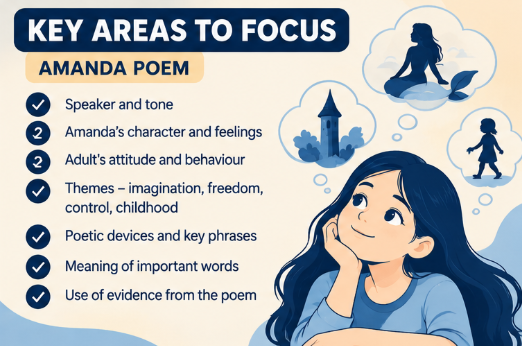
Q13. How would you characterise the speaker in the poem ‘Amanda!’? List any two qualities, supporting the reason of your choice, with evidence from the poem. [CBSE Question Bank]
Ans: The speaker in “Amanda!” can be characterised as:
1. Strict: The speaker constantly corrects Amanda’s behaviour, as shown in the lines “Don’t bite your nails, Amanda!” and “Did you finish your homework, Amanda?” This shows that the speaker is focused on discipline and wants Amanda to follow rules.
2. Controlling: The speaker closely monitors Amanda’s actions, even small tasks, as seen in the line, “I thought I told you to clean your shoes, Amanda!” This suggests a strong desire to direct and control Amanda’s behaviour.
Q14. ‘Amanda is alone but not lonely in the world she envisions.’ Give instances from the poem to justify. [CBSE 2022, CBSE Question Bank (Modified)]
Ans: Amanda is alone but not lonely in the world she envisions because her fantasies reflect peace and freedom, not isolation or sadness. Here are two instances from the poem that support this:
1. Mermaid fantasy: In the lines “There is a languid, emerald sea, where the sole inhabitant is me — a mermaid, drifting blissfully,” Amanda imagines herself as a mermaid, enjoying the calm and solitude of the sea. She is alone but feels blissful and peaceful, showing that she finds comfort in being by herself.
2. Rapunzel fantasy: In the lines “I am Rapunzel, I have not a care; life in a tower is tranquil and rare,” Amanda imagines herself as Rapunzel in a quiet, peaceful tower. Even though she is isolated, Amanda feels content and undisturbed, showing she finds joy in her imagined solitude rather than feeling lonely.
Q15. What does the contrast between the speaker’s commands and Amanda’s orphan daydream suggest about her imaginative escape? [AQP 2024]
Ans: The contrast between the speaker’s strict commands and Amanda’s orphan daydream suggests that Amanda’s imaginative escape is her way of coping with the pressure of constant control. While the speaker’s commands focus on discipline and responsibilities, Amanda’s daydream of being an orphan symbolises her desire for freedom and independence. This contrast shows that Amanda uses her imagination as a refuge to experience peace and autonomy. She is free from rules, supervision and expectations in her daydream.
Q16. This is Calvin, a character from a comic strip created by Bill Watterson.

Do you think this might be something Amanda would say? Why/why not? Give reasons. [CBSE Question Bank]
Ans: Yes, Amanda might say something similar to Calvin’s quote, “It’s not denial. I’m just very selective about the reality I accept”. Amanda uses her imagination to create an alternative reality where she feels free and in control just like Calvin in the comic strip. Amanda does not directly deny or argue with the commands of the adult speaker, but she chooses to mentally escape into her daydreams.
These fantasies offer her peace and freedom, which are absent in her real-life situation filled with strict rules and expectations. This suggests that Amanda, like Calvin, is not rejecting reality outright, but instead selectively chooses to retreat into a world that gives her comfort and independence.
Q17. Look at the given image of a book cover.

If the author, Jason Kotecki were to ask a grown-up Amanda to help with his book by writing one of the 8 secrets based on her experiences, what might she share? Elaborate based on your understanding of the poem. [CBSE Question Bank]
Ans: If a grown-up Amanda were to contribute to Jason Kotecki’s book “Escape Adulthood: 8 Secrets from Childhood for the Stressed-Out Grown-Up”, she might share a secret about the power of imagination as a coping mechanism. Based on her childhood experiences described in the poem “Amanda!”, she often found herself overwhelmed by constant instructions and expectations from adults. She learned to cope with this harsh reality by escaping into her imagination to find peace and freedom.
As an adult, Amanda might advise people to reconnect with the childlike ability to dream and imagine. She could explain how imagination is not only a tool for children but can also serve adults as a means to break free from stressful routines, offering a mental escape from the pressures of life. Her secret might encourage adults to regularly indulge in creative thinking and quiet mental escapes to preserve emotional well-being and a sense of inner calm.
18. Read the following extract, and answer the questions that follow.
Don’t eat that chocolate, Amanda!
Remember your acne, Amanda!
Will you please look at me when I’m speaking to you, Amanda!
(I am Rapunzel, I have not a care;
life in a tower is tranquil and rare;
I will certainly never let down my bright hair.) [CBSE 2022–23]
Why does Amanda wish to be a mermaid? [3 mark] [CBSE 2022–23]
Answer: Amanda wishes to be a mermaid because she wants to escape from the constant instructions and scolding of adults. She imagines herself drifting peacefully in the calm, emerald sea. The mermaid represents freedom, solitude and a peaceful life without rules or restrictions.
19. Read the following extract, and answer the questions that follow.
Don’t eat that chocolate, Amanda!
Remember your acne, Amanda!
Will you please look at me when I’m speaking to you, Amanda!
(I am Rapunzel, I have not a care;
life in a tower is tranquil and rare;
I will certainly never let down my bright hair.) [CBSE 2022–23]
What impression do you form about Amanda in the poem?
Answer: Amanda appears to be a sensitive, imaginative and freedom-loving child. She feels restricted by the constant instructions and corrections of adults. Therefore, she escapes into her imagination and dreams of being a mermaid, an orphan and Rapunzel. These fantasies reveal her desire for peace, privacy and independence.
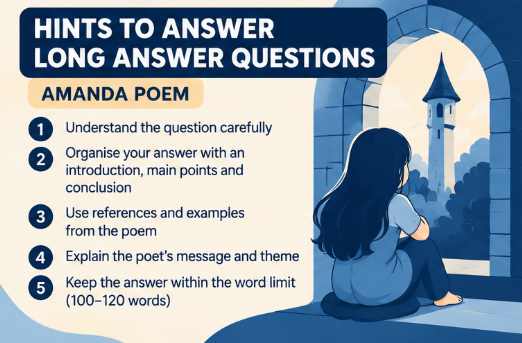
20. Answer the following question in about 100–120 words. [6 marks] [CBSE 2022–23]
It is said that “Children are not things to be moulded, but people to be unfolded.” Discuss with reference to the poem “Amanda!”.
Answer: The statement means that children should be allowed to develop their own personalities instead of being forced to follow strict rules and expectations. The poem Amanda! by Robin Klein highlights this idea through Amanda’s experiences. Amanda’s mother constantly corrects her behaviour. She tells Amanda not to bite her nails, not to hunch her shoulders and to finish her homework. Although these instructions may come from concern, their constant repetition makes Amanda feel restricted.
As a result, she escapes into her imagination, dreaming of being a mermaid, an orphan and Rapunzel. The poem suggests that children need love, understanding and personal space. Parents should guide them with patience rather than constantly criticising them. Every child has unique feelings, interests and dreams. Children should be encouraged to express themselves and grow naturally into confident individuals.