POETIC DEVICES IN AMANDA POEM ALONG WITH SYMBOLISM AND TONE AND RHYTHM OF THE POEM
Poetic Devices in “Amanda!”
The poem Amanda! uses poetic devices to show the contrast between Amanda’s strict, everyday life and her imaginative world, where she dreams of peace, freedom, and independence.
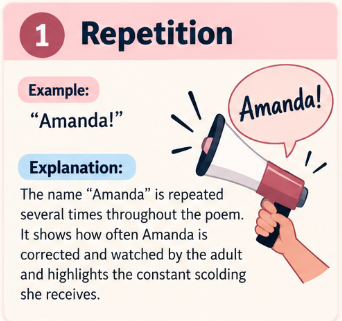
1. Repetition
Example: “Amanda!”
Explanation: The name “Amanda” is repeated several times in the poem. This shows that the adult keeps calling her and correcting her behaviour. It also makes Amanda feel as if she is constantly being watched and scolded.
Exam tip: Repetition means using the same word or phrase more than once to create emphasis.
2. Anaphora
Examples:
(a) “Don’t bite your nails, Amanda! / Don’t hunch your shoulders, Amanda!”
(b) “Did you finish your homework, Amanda? / Did you tidy your room, Amanda?”
Explanation: In the first example, the word “Don’t” is repeated at the beginning of consecutive lines. In the second, the words “Did you” are repeated at the beginning of consecutive questions. This highlights the continuous instructions and questions directed at Amanda.
Exam tip: Anaphora is the repetition of a word or group of words at the beginning of successive lines or sentences.
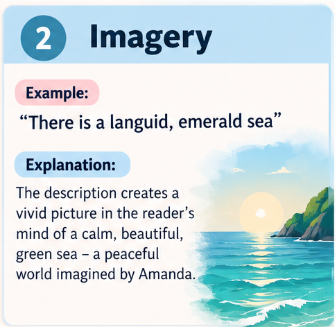
3. Imagery
Example: “There is a languid, emerald sea”
Explanation: These words help readers imagine a calm, beautiful, green sea. Amanda imagines herself in a peaceful world, far away from the constant instructions of the adult.
- Languid: Calm, slow, and relaxed.
- Emerald: Bright green, like the precious stone emerald.
Exam tip: Imagery uses descriptive language to create a picture or sensation in the reader’s mind.
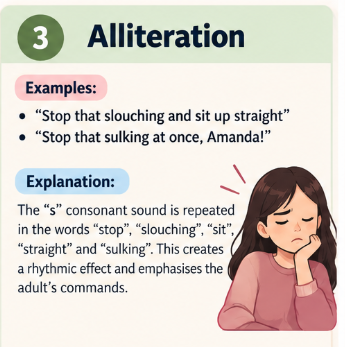
4. Alliteration
Examples:
(a) “Stop that slouching and sit up straight”
(b) “Stop that sulking at once, Amanda!”
Explanation: The consonant sound “s” is repeated in words such as “Stop,” “slouching,” “sit,” “straight,” and “sulking.” This repetition creates a rhythmic effect and draws attention to the adult’s commands.
Exam tip: Alliteration is the repetition of the same initial consonant sound in nearby words.
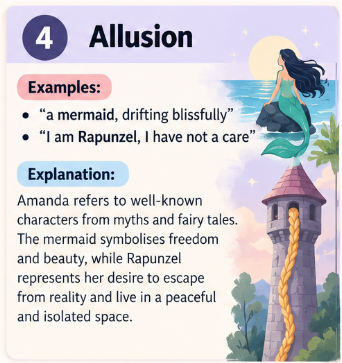
5. Allusion
Examples:
(a) “a mermaid, drifting blissfully”
(b) “I am Rapunzel, I have not a care”
Explanation:
- Mermaid: Amanda imagines herself as a mermaid living freely in a peaceful sea. This represents her desire to escape the adult’s commands and enjoy freedom.
- Rapunzel: Amanda refers to the famous fairy-tale character Rapunzel, who was locked in a tower. By imagining herself as Rapunzel, Amanda expresses her wish to escape her present reality and live peacefully in her own world.
Exam tip: Allusion is an indirect reference to a famous person, character, story, myth, or historical event.
6. Transferred Epithet
Example: “I pattern soft dust with my hushed, bare feet”
Explanation: The word “hushed” usually describes a quiet person, voice, or environment. Here, it is used to describe Amanda’s bare feet. The expression suggests that Amanda is walking silently and gently, without disturbing the peaceful surroundings of her imagination.
Exam tip: A transferred epithet is a figure of speech in which an adjective is transferred from the person or thing it logically describes to another closely associated noun.
7. Metaphor
Example: “The silence is golden, the freedom is sweet”
Explanation: This line contains two metaphors.
- “The silence is golden” means that silence is extremely valuable and precious to Amanda.
- “The freedom is sweet” means that freedom gives Amanda great happiness and pleasure.
The poet compares silence to gold and freedom to something sweet without using the words “like” or “as”.
Exam tip: A metaphor directly compares two different things without using “like” or “as”.
8. Contrast
Example: The adult’s commands and criticisms are contrasted with Amanda’s peaceful fantasies.
Explanation: The poem presents two very different worlds. In the real world, Amanda is constantly instructed and corrected by the adult. In her imaginary world, she dreams of being a mermaid or Rapunzel, enjoying peace and freedom.
This contrast highlights the difference between Amanda’s restrictive reality and her desire for independence.
Exam tip: Contrast means showing the difference between two opposite ideas, situations, characters, or experiences.
RHYME SCHEME OF AMANDA
First stanza (adult’s instructions): AABA
Don’t bite your nails, Amanda! (a)
Don’t hunch your shoulders, Amanda! (a)
Stop that slouching and sit up straight, (b)
Amanda! (a)
Second stanza (Amanda’s imagination): C C C
(There is a languid, emerald sea, (c)
where the sole inhabitant is me— (c)
a mermaid, drifting blissfully.) (c)
Explanation: The first stanza follows the rhyme pattern AABA, while the second stanza follows CCC, as indicated in your textbook extract. The poem alternates between the adult’s instructions and Amanda’s imaginative thoughts, highlighting the contrast between her real life and her desire for freedom.
TONE OF THE AMANDA POEM
The poem Amanda! reflects different tones that highlight the contrast between the adult’s strict instructions and Amanda’s desire for freedom and peace.
1. Authoritative and Critical Tone
The adult speaks to Amanda in a strict and commanding manner. The adult repeatedly gives instructions and corrects her behaviour.
Examples:
- “Don’t bite your nails, Amanda!”
- “Will you please look at me when I’m speaking to you?”
The adult wants Amanda to follow rules and behave properly. This creates a feeling of restriction and frustration in Amanda.
2. Dreamy and Peaceful Tone
Whenever Amanda imagines herself in a different world, the tone becomes calm, dreamy, and peaceful.
Examples:
- “There is a languid, emerald sea”
- “I am Rapunzel, I have not a care”
Amanda imagines herself as a mermaid or Rapunzel to escape the pressure of everyday life. Her fantasies represent her desire for peace, freedom, and independence.
3. Exasperated Tone
Towards the end of the poem, the adult becomes irritated and frustrated with Amanda’s behaviour.
Example: “Stop that sulking at once, Amanda!”
The adult also accuses Amanda of being moody and sulking. The adult becomes impatient because Amanda appears withdrawn and does not respond as expected. This shows the lack of understanding between the adult and Amanda.
So, the poem alternates between the adult’s strict, authoritative tone and Amanda’s dreamy, peaceful tone. Towards the end, the adult’s voice also reflects exasperation. This contrast highlights the central theme of the poem: the conflict between parental control and a child’s desire for freedom and independence.
Quick Revision Table
| Tone | Meaning | What it reveals |
| Authoritative | Strict and commanding | Adult’s control over Amanda |
| Critical | Correcting and pointing out faults | Constant criticism of Amanda |
| Dreamy | Lost in imagination | Amanda’s desire to escape reality |
| Peaceful | Calm and free from worries | Amanda’s longing for freedom |
| Exasperated | Irritated and impatient | Adult’s frustration with Amanda |
CBSE Exam tip: If asked about the tone of Amanda!, mention the contrast between the adult’s authoritative and critical tone and Amanda’s dreamy and peaceful tone. You may also mention the adult’s exasperation towards the end.
SYMBOLISM IN AMANDA POEM
Symbolism is used in the poem Amanda! to express Amanda’s longing for freedom and her desire to escape the adult’s constant control.
1. Mermaid
Symbolism: Freedom and solitude.
Explanation: Amanda imagines herself as a mermaid drifting alone in a calm sea. The mermaid symbolises Amanda’s desire for peaceful isolation, where she can be free from the adult’s demands and live without restrictions. Amanda wants to live peacefully, away from constant instructions and scolding.
2. Orphan
Symbolism: Independence and freedom from authority.
Explanation: Amanda imagines herself as an orphan, with no adult to control her actions. This symbolises her yearning for complete freedom and independence, without the pressure of constant instructions or responsibilities. Amanda imagines being an orphan because she wants to make her own decisions without anyone constantly correcting her.
3. Rapunzel
Symbolism: Personal space and control over one’s life.
Explanation: Amanda imagines herself as Rapunzel, who is locked in a tower away from the real world. This symbolises Amanda’s desire for complete isolation, where she can live undisturbed and free from external control. In the original fairy tale, Rapunzel’s hair serves as a means for the prince to enter her tower. However, Amanda chooses not to let down her hair in her imagination, symbolising her refusal to allow anyone to enter her personal space or control her. In simple words, Amanda wants to be left alone in her own peaceful world, where nobody interferes with her life.
| Symbol | What it represents |
| Mermaid | Freedom and solitude |
| Orphan | Independence and freedom from authority |
| Rapunzel | Personal space and control over one’s life |
Important CBSE exam point: All three symbols reflect Amanda’s desire to escape constant instructions and enjoy freedom, peace, and independence.