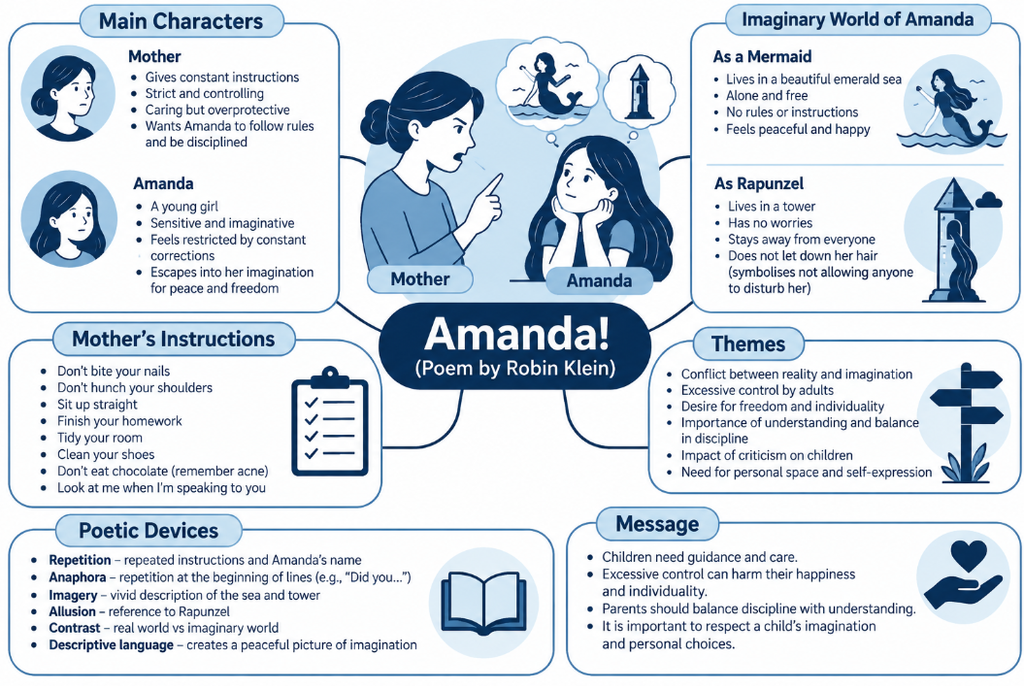
EXTRACT – 1
Read the extract given below and answer the questions that follow.
Don’t bite your nails, Amanda!
Don’t hunch your shoulders, Amanda!
Stop that slouching and sit up straight,
Amanda!
SET–I
(i) What emotions are most appropriately conveyed by the repeated commands in the stanza?
- Control
- Irritation
- Concern
- Encouragement
- Authority
Choose the correct option:
(a) 1, 2, 5
(b) 2, 3, 4
(c) 1, 3, 5
(d) 2, 4, 5
Answer: (a) 1, 2, 5
Explanation: The repeated commands show that the speaker wants to control Amanda’s behaviour. The tone also suggests irritation and authority because the speaker keeps correcting her.
(ii) What does the repetition of the name “Amanda!” suggest about the speaker’s tone?
Answer: The repetition of “Amanda!” suggests an impatient, irritated, and commanding tone.
(iii) Which phrase from the extract reflects repeated verbal control over Amanda’s personal habit rather than her posture?
Answer: “Don’t bite your nails, Amanda!”
(iv) Fill in the blank with a phrase to suitably complete the sentence.
The repeated instructions symbolise __________ on Amanda’s freedom.
Answer: restrictions
(v) What does the poet imply about Amanda’s daily life through these commands?
(a) It is guided by balanced discipline and care.
(b) It allows freedom with occasional correction.
(c) It encourages independence through guidance.
(d) It is dominated by rules and constant correction.
Answer: (d) It is dominated by rules and constant correction.
Explanation: Amanda is repeatedly told how to behave and sit. This suggests that she has little freedom and faces constant correction in her daily life.
(vi) Complete the following suitably.
The word “slouching” in the line “Stop that slouching and sit up straight,” refers to __________ posture.
Answer: a bent or drooping posture
(vii) How does repetition reinforce the central message of the stanza?
Answer: The repetition highlights the constant instructions and corrections Amanda receives. It reinforces the idea that the speaker tries to control her behaviour.
(viii) Identify the phrase in the extract that is advisory in nature.
Answer: “Stop that slouching and sit up straight.”
SET–II
(i) Fill in the blank with ONE word.
The speaker in these lines most probably is Amanda’s __________.
Answer: mother
(ii) The extract suggests that in the eyes of the speaker, Amanda
- has problems with posture
- has got a habit of day-dreaming
- exhibits a lack of obedience
- is not a cultured girl
- considers herself to be very beautiful
Choose the correct option:
(a) Options 1, 4, 5
(b) Options 1, 3, 4
(c) Options 3, 4, 5
(d) Options 2, 3, 5
Answer: (a) Options 1, 4, 5
Explanation: The extract directly shows the speaker correcting Amanda’s posture. However, the claims about culture and beauty are not clearly supported by these particular lines. The question or its options may refer to a wider extract from the poem.
(iii) Comment on the poet’s use of literary devices in this extract.
Answer: The poet uses repetition in the words “Amanda!” and commands such as “Don’t bite your nails.” The repetition emphasises the speaker’s constant instructions. The imperative sentences create a commanding tone.
(iv) What impression of the speaker do you form from this extract?
Answer: The speaker appears strict, controlling, and concerned about Amanda’s behaviour and posture. The repeated commands also suggest impatience.
(v) Fill in the blank with ONE word.
The repetition of “Amanda!” at the end of each line in the extract shows the speaker’s __________.
Answer: impatience
(vi) How does the poet show the difference between the speaker’s expectations and Amanda’s likely feelings?
Answer: The speaker expects Amanda to follow rules and maintain proper posture. Amanda likely feels restricted and frustrated because she receives repeated instructions and has little freedom to behave as she wishes.
Extract 2
Read the extract given below and answer the questions that follow.
There is languid Emerald Sea
Where the sole inhabitant is me—
a mermaid, drifting blissfully.
SET–I
(i) What emotions are most appropriately conveyed by the images “languid” and “drifting blissfully”?
- Freedom
- Peace
- Loneliness
- Anxiety
- Contentment
Choose the correct option:
(a) 2, 3 and 4
(b) 1, 3 and 4
(c) 3, 4 and 5
(d) 1, 2 and 5
Answer: (d) 1, 2 and 5
Explanation: “Drifting blissfully” suggests peace and contentment. Amanda imagines a world where she is free from rules and restrictions. Therefore, freedom, peace, and contentment are the most appropriate emotions.
(ii) What does the phrase “the sole inhabitant is me” suggest about Amanda’s state of mind?
Answer: It suggests that Amanda wants to be alone and enjoy freedom without anyone controlling or disturbing her.
(iii) Which phrase from the extract conveys Amanda’s escape from external control?
Answer: “the sole inhabitant is me”
(iv) Fill in the blank with a phrase to suitably complete the sentence.
Amanda’s imagined sea symbolises __________ from control and constant supervision.
Answer: freedom
(v) What does the poet imply by presenting Amanda as a “mermaid” in this extract?
(a) Amanda longs for beauty and admiration.
(b) Amanda feels disconnected from reality.
(c) Amanda desires freedom and a life beyond restrictions.
(d) Amanda wishes to live underwater permanently.
Answer: (c) Amanda desires freedom and a life beyond restrictions.
Explanation: Amanda imagines herself as a mermaid living peacefully in the sea. This imaginary world allows her to escape the rules and constant instructions of the real world.
(vi) Complete the following suitably.
The word “languid” in the extract refers to __________ movement.
Answer: slow and relaxed
(vii) How does imagery help contrast Amanda’s inner world with her real life?
Answer: The peaceful sea represents Amanda’s imaginary world of freedom and happiness. It contrasts with her real life, where she faces repeated instructions and restrictions.
(viii) Identify the phrase in the extract that reflects a sense of contentment.
Answer: “drifting blissfully”
SET–II
(i) State whether the following statement is TRUE or FALSE.
The speaker’s real world is as blissful as that of the mermaids.
Answer: FALSE
(ii) What is the poet’s purpose of putting the lines in brackets?
Answer: The brackets separate Amanda’s imaginary thoughts from the speaker’s instructions. They help the reader understand Amanda’s desire to escape into her own world.
(iii) How does the poet’s shift from the real-world criticism to the imagined mermaid world show a contrast?
Answer: The real world contains rules, criticism, and constant instructions. In contrast, Amanda’s imagined mermaid world offers peace, freedom, and independence.
(iv) How does the poet’s use of descriptive language, such as “emerald sea” and “drifting blissfully”, make the poem relatable or impactful?
Answer: The descriptive language helps readers imagine Amanda’s peaceful world. It makes her desire for freedom clear and helps readers understand her feelings of frustration with constant restrictions.
EXTRACT 3
Read the extract given below and answer the questions that follow.
Did you finish your homework, Amanda?
Did you tidy your room, Amanda?
I thought I told you to clean your shoes,
Amanda!
SET–I
(i) What emotions are most appropriately conveyed by the repeated questions in this extract?
- Pressure
- Irritation
- Authority
- Encouragement
- Reassurance
Choose the correct option:
(a) 1, 2 and 4
(b) 2, 4 and 5
(c) 1, 2 and 3
(d) 3, 4 and 5
Answer: (c) 1, 2 and 3
Explanation: The repeated questions create pressure on Amanda. The speaker sounds irritated and authoritative while checking whether Amanda has completed her daily tasks. The questions do not mainly express encouragement or reassurance.
(ii) What does the questioning pattern in the extract suggest about the speaker’s approach to discipline?
Answer: It suggests that the speaker follows a strict approach to discipline and regularly checks Amanda’s activities.
(iii) Which phrase from the extract reflects the speaker’s assumption of prior instructions and expectation of compliance?
Answer: “I thought I told you to clean your shoes”
(iv) Fill in the blank with a phrase to suitably complete the sentence.
The repeated questions symbolise __________ in Amanda’s daily routine.
Answer: constant supervision and control
(v) What does the poet imply about the nature of discipline imposed over Amanda in this extract?
(a) It encourages responsibility through trust.
(b) It allows space for self-correction.
(c) It balances rules with understanding.
(d) It relies on repetition and control.
Answer: (d) It relies on repetition and control.
Explanation: The speaker repeatedly asks Amanda about her homework, room, and shoes. This shows that discipline is imposed through frequent questioning and correction rather than trust or understanding.
(vi) Complete the following suitably.
The word “tidy” in the line “Did you tidy your room, Amanda?” refers to __________.
Answer: cleaning and organising
(vii) How does this extract strengthen the poem’s portrayal of Amanda’s restricted freedom?
Answer: The extract shows that Amanda is constantly questioned about her homework, room, and shoes. This suggests that she has little freedom and faces continuous supervision.
SET–II
(i) Complete the following suitably.
It is clear that ‘anaphora’ is the poetic device used in the first two lines because __________.
Answer: the same words, “Did you”, are repeated at the beginning of both lines.
(ii) Two qualities of the speaker’s attitude that are evident in this extract are:
- Caring
- Flattering
- Indifferent
- Inquisitive
- Overbearing
Choose the correct option:
(a) Options 1 and 2
(b) Options 1 and 4
(c) Options 2 and 3
(d) Options 4 and 5
Answer: (d) Options 4 and 5
Explanation: The speaker asks repeated questions to check Amanda’s activities. This shows an inquisitive attitude. The repeated instructions also suggest an overbearing or controlling nature.
(iii) Fill in the blank with ONE word only.
The speaker gives the impression that Amanda is a/an __________ girl.
Answer: careless
(iv) How does the poet show the difference between Amanda’s imagination and her reality in this part of the poem?
Answer: Amanda’s reality is filled with instructions and constant questioning. Her imagination offers an escape from these restrictions and allows her to feel free.
EXTRACT 4
Read the extract given below and answer the questions that follow.
Don’t eat that chocolate, Amanda!
Remember your acne, Amanda!
Will you please look at me when I’m speaking to you,
Amanda!
SET–I
(i) What emotions are most appropriately conveyed by the speaker’s remarks in this extract?
- Irritation
- Impatience
- Embarrassment
- Anger
- Reassurance
Choose the correct option:
(a) 1, 2, 3
(b) 1, 2, 4
(c) 2, 3, 5
(d) 3, 4, 5
Answer: (b) 1, 2, 4
Explanation: The speaker’s repeated instructions show irritation and impatience. The demand that Amanda look at the speaker also suggests anger and frustration.
(ii) What does the remark “Remember your acne” suggest about how the speaker tries to influence Amanda?
Answer: The speaker tries to control Amanda’s eating habits by reminding her that eating chocolate may worsen her acne.
(iii) Which phrase from the extract shows that the speaker expects Amanda’s full attention at that moment?
Answer: “Will you please look at me when I’m speaking to you”
(iv) Fill in the blank with a phrase to suitably complete the sentence.
The speaker’s remarks indicate __________ in Amanda’s personal choices.
Answer: interference and control
(v) What does the poet imply about the effect of such remarks on Amanda?
(a) They help Amanda become disciplined.
(b) They make Amanda more confident.
(c) They limit Amanda’s emotional space.
(d) They encourage healthy habits.
Answer: (c) They limit Amanda’s emotional space.
Explanation: The speaker repeatedly comments on Amanda’s eating habits, appearance, and behaviour. Such constant correction can make Amanda feel restricted and reduce her sense of independence.
(vi) Complete the following suitably.
The line “Don’t eat that chocolate, Amanda!” refers to __________ being regulated.
Answer: Amanda’s eating habits
(vii) How does this extract strengthen the poem’s theme of loss of individuality?
Answer: The extract shows that the speaker controls Amanda’s food choices and demands her attention. This suggests that Amanda is not given enough freedom to make her own choices or express herself independently.
SET–II
(i) Complete the following with suitable information from the extract.
| Cause | Effect |
| Amanda eats chocolates | __________ |
Answer: The speaker reminds Amanda about her acne and tells her not to eat chocolate.
(ii) What kind of parenting has Amanda got? How has it affected her?
Answer: Amanda has strict and overprotective parenting. The constant instructions make her feel restricted and encourage her to escape into her imagination.
(iii) Which is the BEST THING to do for a child who is treated like Amanda?
(a) She should ignore and rebel against her parents.
(b) She should not talk to the perpetrator of the ill-treatment.
(c) She should seek help from someone mature, compassionate and trustworthy.
(d) She should wait for the situation to improve on its own.
Answer: (c) She should seek help from someone mature, compassionate and trustworthy.
Explanation: A mature and trustworthy person can listen to the child, understand her feelings, and help her find a healthy solution. Ignoring the problem or rebelling may not resolve the situation.
(iv) The extract presents Amanda as a/an __________ girl.
Answer: unhappy
(iv) The extract presents Amanda as a/an __________ girl.
Choose the correct option:
(a) obedient
(b) responsible
(c) stubborn
(d) sensitive
Answer: (d) sensitive
Explanation: Amanda appears sensitive because she does not respond positively to constant instructions and seems to escape into her imagination. The extract suggests that the speaker’s repeated corrections affect her emotional freedom.
(v) Which of the following DOES NOT COMPLETE the following statement in an appropriate way?
The speaker does not like the way Amanda __________.
(a) looks at her while being spoken to
(b) avoids looking into her eyes while being spoken to
(c) seems to ignore her while speaking to her
(d) adopts a careless, casual attitude to what she has to say
Answer: (a) looks at her while being spoken to
Answer explanation: The speaker asks Amanda to look at her while she is speaking. Therefore, looking at the speaker is not the behaviour that the speaker dislikes.
(vi) How does the poet show the difference between Amanda’s desires and the speaker’s expectations?
Answer: Amanda desires freedom, peace, and independence. The speaker expects her to follow instructions and behave properly. This contrast highlights Amanda’s wish to escape constant control.
Extract 5
Read the extract given below and answer the questions that follow.
(I am Rapunzel, I have not a care;
life in a tower is tranquil and rare;
I’ll certainly never let down my bright hair!)
SET–I
(i) What emotions are most appropriately conveyed by the phrase “tranquil and rare”?
- Peace
- Suffering
- Carefreeness
- Fear
- Satisfaction
Choose the correct option:
(a) 1, 4, 5
(b) 2, 3, 4
(c) 1, 3, 5
(d) 2, 4, 5
Answer: (c) 1, 3, 5
Explanation: The words suggest peace, freedom from worries, and satisfaction. Amanda imagines living peacefully in a tower without interference from others.
(ii) What does the line “I have not a care” suggest about Amanda’s emotional state in this fantasy?
Answer: It suggests that Amanda feels peaceful and free from worries in her imaginary world.
(iii) Which phrase from the extract conveys Amanda’s desire to remain undisturbed and unreachable?
Answer: “I’ll certainly never let down my bright hair!”
(iv) Fill in the blank with a phrase to suitably complete the sentence.
Amanda’s identification with Rapunzel symbolises __________.
Answer: her desire for freedom, solitude, and escape from control
(v) What does the poet imply by Amanda choosing to be Rapunzel in this extract?
(a) Amanda wants admiration for her beauty.
(b) Amanda fears social contact.
(c) Amanda seeks a protected life away from control.
(d) Amanda wishes to be famous and admired.
Answer: (c) Amanda seeks a protected life away from control.
Explanation: Amanda imagines herself living peacefully in a tower and refuses to let down her hair. This suggests that she wants to remain undisturbed and escape the constant instructions of the real world.
(vi) Complete the following suitably.
The word “tower” in the line “life in a tower is tranquil and rare” refers to __________.
Answer: a place of solitude and isolation
(vii) How does this extract deepen the poem’s theme of escape into imagination?
Answer: Amanda imagines herself as Rapunzel living peacefully in a tower. This fantasy allows her to escape the rules, instructions, and expectations of her real life.
SET–II
(i) The extract has a reference to a __________.
(a) folk tale
(b) fable
(c) mythological tale
(d) fairy tale
Answer: (d) fairy tale
Explanation: Rapunzel is a well-known character from a fairy tale. In the poem, Amanda imagines herself living like Rapunzel in a tower.
(ii) Comment on the use of the literary device “allusion” in these lines.
Answer: The poet uses an allusion to Rapunzel, a character from a fairy tale. This reference highlights Amanda’s desire for solitude and freedom from interference.
(iii) How would you explain the use of brackets in these lines?
Answer: The brackets show Amanda’s imaginary thoughts. They distinguish her fantasy from the speaker’s instructions in the real world.
(iv) Why is the phrase “I’ll certainly never let down my bright hair” important in the extract?
Answer: The phrase shows Amanda’s determination to remain isolated and undisturbed. It reflects her desire to avoid contact and escape external control.
(v) How does the poet show the difference between Amanda’s imagination as Rapunzel and her real life?
Answer: In her imagination, Amanda enjoys peace, solitude, and freedom. In real life, she faces repeated instructions and constant supervision. This contrast highlights her desire to escape restrictions.