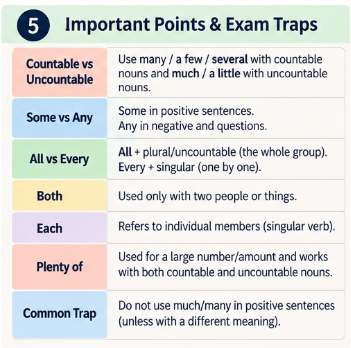
MEANING OF QUANTIFIERS DETERMINERS
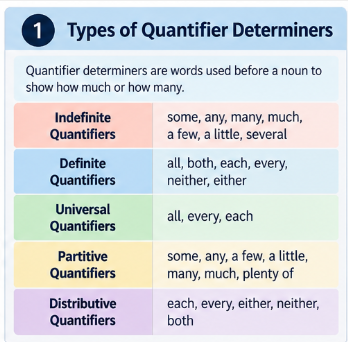
Quantifiers determiners are determiners that indicate the number or amount of people, animals, things or substances. They tell us how many or how much of something we are talking about.
Examples:
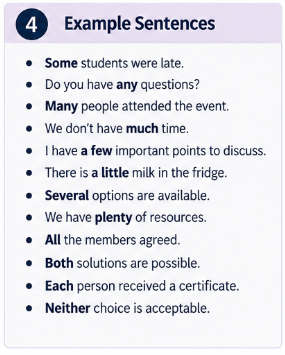
- Many students attended the class.
- Much water was wasted.
- Few people understood the question.
- Some milk is left.
- Several books are missing.
The most important rule is to identify whether the noun is countable or uncountable before choosing a quantifier.
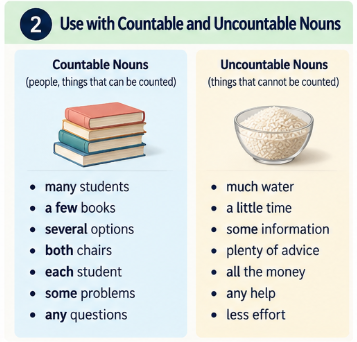
COUNTABLE VS UNCOUNTABLE NOUNS
| Basis | Countable Nouns | Uncountable Nouns |
| Meaning | Things that can be counted individually | Things treated as a mass, substance, or general concept |
| Examples | books, students, chairs, apples | water, milk, money, advice, information |
| Many / Much | Many books | Much water |
| Few / Little | Few students | Little water |
| Number | Three books | Not normally three waters when referring to water generally |
| Verb agreement | These books are useful. | This information is useful. |
Exam tip: Words such as advice, information, furniture, luggage, equipment, and news are generally uncountable in standard English.
- Correct: much information
- Incorrect: many informations
- Correct: a piece of advice
- Incorrect: an advice
MANY VS MUCH VS A LOT OF– QUANTIFIERS DETERMINERS
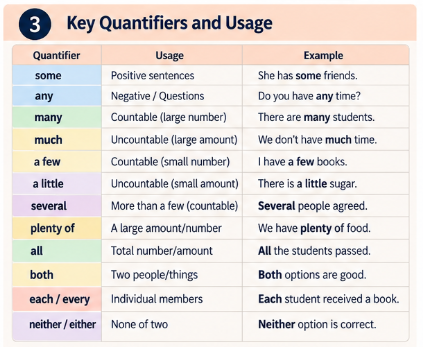
| Quantifier | Used With | Meaning | Example |
| Many | Countable plural nouns | A large number | Many students were absent. |
| Much | Uncountable nouns | A large amount | We do not have much time. |
| A lot of | Countable plural and uncountable nouns | A large number or amount | A lot of people came. / A lot of water was wasted. |
| Lots of | Countable plural and uncountable nouns | A large number or amount; informal | Lots of books are available. |
| Plenty of | Countable plural and uncountable nouns | More than enough | We have plenty of chairs. / We have plenty of food. |
| A great deal of | Uncountable nouns | A large amount | A great deal of effort was required. |
| A large number of | Countable plural nouns | A large number | A large number of applicants applied. |
| A large amount of | Uncountable nouns | A large amount | A large amount of money was spent. |
IMPORTANT COMPARISON
| Sentence | Explanation |
| How many books do you have? | Books are countable. |
| How much money do you have? | Money is uncountable. |
| There aren’t many chairs. | Countable plural noun in a negative sentence. |
| There isn’t much milk. | Uncountable noun in a negative sentence. |
| There are a lot of students. | Correct with a plural countable noun. |
| There is a lot of traffic. | Correct with an uncountable noun. |
FEW VS A FEW VS THE FEW – QUANTIFIERS DETERMINERS
These three expressions are used with countable plural nouns, but their meanings are different.
| Quantifier | Meaning | Sense | Example |
| Few | Almost none; not enough | Negative | Few students passed the difficult test. |
| A few | Some; a small number | Positive | A few students helped me. |
| The few | The small number that exists or is available | Specific | The few friends I have are very loyal. |
COMPARISON THROUGH SITUATIONS
| Sentence | What It Means |
| I have few friends. | I have almost no friends; this is presented as a problem. |
| I have a few friends. | I have some friends. |
| The few friends I have support me. | I am referring to the particular small number of friends I have. |
Exam trap: Do not use few and a few interchangeably when the meaning matters.
- He has few opportunities: Almost no opportunities.
- He has a few opportunities: Some opportunities.
LITTLE VS A LITTLE VS THE LITTLE – QUANTIFIERS DETERMINERS
These three expressions are used with uncountable nouns.
| Quantifier | Meaning | Sense | Example |
| Little | Almost no amount; not enough | Negative | There is little hope of success. |
| A little | Some amount | Positive | There is a little milk in the fridge. |
| The little | The small amount that exists or is available | Specific | The little money he had was spent on food. |
COMPARISON THROUGH SITUATIONS
| Sentence | What It Means |
| I have little money. | I have almost no money. |
| I have a little money. | I have some money. |
| The little money I have is for emergencies. | I am referring to the specific small amount of money I possess. |
Golden rule
| Countable Plural | Uncountable |
| Few | Little |
| A few | A little |
| The few | The little |
- Few students attended.
- Little water remained.
Never confuse few with little when the noun type is clear.
SOME VS ANY – QUANTIFIERS DETERMINERS
Both words refer to an unspecified quantity or number.
| Basis | Some | Any |
| Common use | Affirmative statements | Negative statements and questions |
| Countable example | I bought some apples. | I didn’t buy any apples. |
| Uncountable example | There is some sugar. | There isn’t any sugar. |
| Offers | Common in offers | Less usual for an ordinary offer |
| Requests | Can be used in requests | Common in neutral questions |
| Example question | Would you like some tea? | Do you have any tea? |
IMPORTANT RULES AND EXCEPTIONS OF QUANTIFIERS DETERMINERS
| Situation | Correct Usage | Example |
| Affirmative sentence | Some | I have some money. |
| Negative sentence | Any | I don’t have any money. |
| General question | Any | Is there any milk? |
| Offer | Some | Would you like some coffee? |
| Polite request | Some | Could I have some water? |
| Meaning of “it doesn’t matter which” | Any | You can choose any book. |
| Meaning of “one or more, it doesn’t matter which” | Any | Any student can participate. |
Exam trap: Do not assume that some is used only in affirmative sentences. Offers and requests commonly use some even in questions.
EACH VS EVERY – QUANTIFIERS DETERMINERS
Both refer to all members of a group, but they present the group differently.
| Basis | Each | Every |
| Main focus | Individual members separately | All members as a group, considered individually |
| Noun | Singular countable noun | Singular countable noun |
| Verb | Singular | Singular |
| Example | Each student received a certificate. | Every student received a certificate. |
| Use with two items | Can be used | Usually less natural when referring to only two distinct items |
| With of | Each of the students | Every one of the students |
| Incorrect construction | Each students | Every students |
RULES TO REMEMBER
| Rule | Correct Example |
| Each + singular noun | Each child has a book. |
| Every + singular noun | Every child has a book. |
| Each of + determiner + plural noun/pronoun | Each of the players is ready. |
| Every one of + determiner + plural noun/pronoun | Every one of the players is ready. |
Exam trap: Although the noun after each of is plural, the subject each is singular, so the verb is generally singular.
- Correct: Each of the boys is ready.
- Incorrect: Each of the boys are ready.
ALL VS BOTH VS HALF
| Quantifier | Use | Example |
| All | The entire group or quantity; often three or more, or an entire mass | All students passed. |
| Both | Two people or things together | Both sisters are doctors. |
| Half | One of two equal parts | Half the cake is gone. |
| All of | The whole of a specified group or quantity | All of the students passed. |
| Both of | The two members of a specified pair | Both of my brothers are doctors. |
| Half of | Half of a specified group or quantity | Half of the students were absent. |
VERB AGREEMENT COMPARISON
| Sentence | Correct Verb |
| All the students are present. | Plural |
| All the water is clean. | Singular |
| Both the girls are ready. | Plural |
| Half the cake is missing. | Singular |
| Half the students are absent. | Plural |
Exam trap: All and half can be used with countable plural and uncountable nouns. Their verb agreement depends on the noun or subject they refer to.
LESS VS FEWER
This is a frequently tested rule in grammar examinations.
| Quantifier | Used With | Meaning | Example |
| Fewer | Countable plural nouns | A smaller number | Fewer students attended today. |
| Less | Uncountable nouns | A smaller amount | We have less time today. |
| The fewest | Countable plural nouns | The smallest number | She made the fewest mistakes. |
| The least | Uncountable nouns | The smallest amount | This task requires the least effort. |
Comparison
| Incorrect | Correct |
| Less students attended. | Fewer students attended. |
| Fewer water was wasted. | Less water was wasted. |
| The least mistakes | The fewest mistakes |
| The fewest effort | The least effort |
Important exception: Less than is standard with measurements, amounts, time and money, even when the noun or unit is countable.
- Less than ten kilometres.
- Less than five minutes.
- Less than ₹100.
SEVERAL, ENOUGH, NO AND ANY – OTHER IMPORTANT QUANTIFIERS DETERMINERS
| Quantifier | Usage | Example |
| Several | More than two, but not many; countable plural nouns | Several candidates were selected. |
| Enough | A sufficient number or amount | We have enough chairs. |
| No | Not any; zero quantity or number | There is no milk. / No students were absent. |
| More | A greater quantity or number | We need more time. |
| Most | The majority or greatest part | Most students enjoy holidays. |
| Most of | The majority of a specified group or quantity | Most of the students passed. |
| Any more / Anymore | Additional quantity; anymore commonly means “any longer” | Do you need any more paper? / I don’t live there anymore. |
| A number of | Several; followed by a plural verb | A number of students are absent. |
| The number of | The total count; followed by a singular verb | The number of students is increasing. |
Special exam trap: A number of vs The number of
| Expression | Meaning | Verb |
| A number of students are absent. | Several students are absent. | Plural |
| The number of students is increasing. | The total count is increasing. | Singular |
QUANTIFIERS DETERMINERS: COMPLETE COMPARISON CHART
Use this table for quick revision.
| Quantifier | Countable Plural Nouns | Uncountable Nouns |
| Many / Much | Many books | Much water |
| Few / Little | Few books | Little water |
| A few / A little | A few books | A little water |
| The few / The little | The few books | The little water |
| Some | Some books | Some water |
| Any | Any books | Any water |
| A lot of / Lots of | Lots of books | Lots of water |
| Plenty of | Plenty of books | Plenty of water |
| Enough | Enough books | Enough water |
| No | No books | No water |
| More / Most | More books / most books | More water / most water |
| Fewer / Less | Fewer books | Less water |
| Several | Several books | Not normally used directly with uncountable nouns |
| A great deal of | Not normally used directly with countable plural nouns | A great deal of water |
| A large number of | A large number of books | Not normally used directly with uncountable nouns |
| A large amount of | Not normally used directly with countable plural nouns | A large amount of water |
COMMON EXAM TRAPS: QUANTIFIERS DETERMINERS
| No. | Sentence | Correct Answer | Reason |
| 1 | There aren’t _____ students in the class. | many | Students is countable plural. |
| 2 | We have very _____ time left. | little | Time is uncountable; the sentence suggests insufficiency. |
| 3 | I have _____ close friends who support me. | a few | Means some friends. |
| 4 | _____ information was provided. | Much / Some | Information is uncountable; the best choice depends on the intended meaning. |
| 5 | Each of the candidates _____ qualified. | is | Each takes a singular verb. |
| 6 | A number of people _____ waiting. | are | A number of takes a plural verb. |
| 7 | The number of applicants _____ risen. | has | The number is singular. |
| 8 | There is _____ milk in the glass, so we cannot make tea. | little | Almost no milk remains. |
| 9 | There is _____ milk left; you can have some. | a little | Some milk remains. |
| 10 | _____ of the two answers is correct. | Neither | Neither means not one nor the other. |
| 11 | We made _____ mistakes this time than last time. | fewer | Mistakes are countable. |
| 12 | We need _____ equipment for the laboratory. | more | Equipment is uncountable. |
| 13 | Would you like _____ tea? | some | Some is common in offers. |
| 14 | You may choose _____ book you like. | any | Any means whichever one you want. |
| 15 | _____ students have submitted their work. | Several | Several is used with countable plural nouns. |