DISTRIBUTIVE DETERMINERS– MEANING
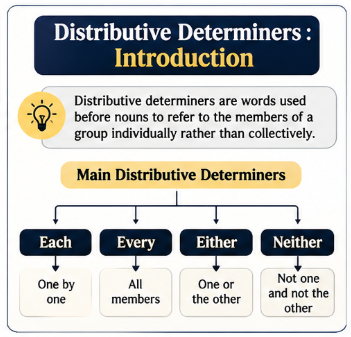
Distributive determiners are words used before nouns to refer to the members of a group individually rather than collectively.
They help us indicate how people or things are considered separately within a group.
For example:
- Each student received a certificate.
- Every employee must follow the rules.
- Either option is acceptable.
- Neither answer is correct.
In these sentences, the determiners focus on individual members or choices within a group of two or more.
Main distributive determiners:
- Each
- Every
- Either
- Neither
Important: Distributive determiners are generally followed by singular countable nouns and take singular verbs. However, their rules and usage are different.
EACH VS EVERY– RULES AND EXAMPLES
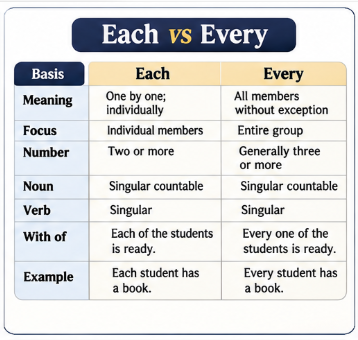
Both each and every refer to individual members of a group. However, they differ in emphasis and usage.

EACH
Individual focus

EVERY
Whole group focus
| Basis | EACH | EVERY |
| Meaning | One by one; individually | All members without exception |
| Focus | Individual members | Entire group |
| Number | Can refer to two or more | Generally refers to three or more |
| Noun | Singular countable noun | Singular countable noun |
| Verb | Singular | Singular |
| Pronoun | Can be followed by of | Cannot directly be followed by of |
| Position | Before a noun or after a noun with a determiner | Before a singular noun |
| Example | Each student has a book. | Every student has a book. |
| Rule | EACH | EVERY |
| Individual reference | Each player received a medal. | Every player received a medal. |
| With a singular noun | Each child is special. | Every child is special. |
| With a singular verb | Each employee works hard. | Every employee works hard. |
| With of | Each of the boys is intelligent. | Every one of the boys is intelligent. |
| With two members | Each of the two sisters is talented. | Every one of the two sisters is talented. |
| With a plural noun | Each student is present. | Every student is present. |
SPECIAL STRUCTURES
| Structure | Example |
| Each + singular noun | Each participant received a gift. |
| Each of + determiner + plural noun | Each of the participants received a gift. |
| Each + of + pronoun | Each of them is responsible. |
| Every + singular noun | Every employee is important. |
| Every one of + determiner + plural noun | Every one of the employees is important. |
| Every + number + plural noun | The magazine is published every two months. |
Remember:
- Each of them is correct.
- Every one of them is correct.
- Every of them is incorrect.
EITHER VS NEITHER– RULES AND EXAMPLES
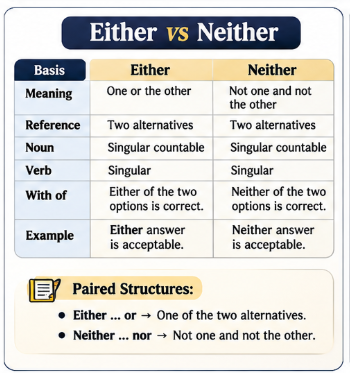
Both either and neither are used when referring to two people or things. However, their meanings are opposite.

EITHER
One or the other

NEITHER
Not one and not the other
| Basis | EITHER | NEITHER |
| Meaning | One or the other | Not one and not the other |
| Number | Two alternatives | Two alternatives |
| Noun | Singular countable noun | Singular countable noun |
| Verb | Singular | Singular |
| Positive/negative meaning | Positive choice | Negative meaning |
| With of | Either of the two options | Neither of the two options |
| Example | Either answer is acceptable. | Neither answer is acceptable. |
| Rule | EITHER | NEITHER |
| Before a singular noun | Either road leads to the station. | Neither road leads to the station. |
| With of | Either of the boys is responsible. | Neither of the boys is responsible. |
| With pronouns | Either of them can win. | Neither of them can win. |
| Referring to two options | You can choose either dress. | You can choose neither dress. |
| With a singular verb | Either candidate is suitable. | Neither candidate is suitable. |
EITHER…OR VS NEITHER….NOR– RULES AND EXAMPLES
These are important paired conjunctions.
| Basis | EITHER…OR | NEITHER…NOR |
| Meaning | One of the two alternatives | Not one and not the other |
| Function | Presents alternatives | Rejects both alternatives |
| Example | Either Rahul or Aman will attend. | Neither Rahul nor Aman will attend. |
| Verb agreement | Agrees with the nearer subject | Agrees with the nearer subject |
Examples:
- Either the teacher or the students are responsible.
- Either the students or the teacher is responsible.
- Neither the manager nor the employees are available.
- Neither the employees nor the manager is available.
Important rule: When subjects connected by either…or or neither…nor differ in number, the verb generally agrees with the subject nearest to it.
EACH VS EITHER
These two determiners are sometimes confused because both can refer to individual members of a group.
| Basis | EACH | EITHER |
| Reference | Two or more members | Only two alternatives |
| Meaning | Every individual considered separately | One or the other |
| Focus | Individual distribution | Choice between alternatives |
| Example | Each student received a book. | Either student can answer. |
| With of | Each of the students | Either of the two students |
| Verb | Singular | Singular |
Understand the difference:
- Each of the two brothers has a bicycle. (Both brothers are considered individually.)
- Either of the two brothers can drive. (One or the other can drive.)
EVERY VS NEITHER
| Basis | EVERY | NEITHER |
| Meaning | All members without exception | Not one of the two |
| Reference | Generally three or more | Two |
| Sense | Inclusive | Negative |
| Example | Every student passed. | Neither student passed. |
| Noun | Singular countable | Singular countable |
| Verb | Singular | Singular |
Examples:
- Every candidate was selected. (All candidates were selected.)
- Neither candidate was selected. (Both candidates were rejected.)
EITHER VS EACH
| Situation | Correct determiner | Example |
| Talking about both members individually | Each | Each of the two girls is talented. |
| Offering one of two choices | Either | Either of the two girls can represent us. |
| Talking about individual distribution | Each | Each student received a separate form. |
| Talking about alternatives | Either | You may choose either option. |
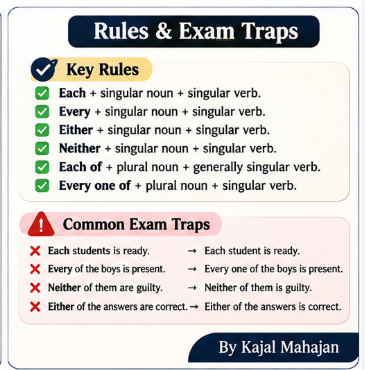
DISTRIBUTIVE DETERMINERS- EXAM TRAPS
These are frequently tested in competitive examinations, placement tests and English grammar assessments.
| No. | Incorrect sentence | Correct sentence | Explanation |
| 1 | Each students is intelligent. | Each student is intelligent. | Each takes a singular noun. |
| 2 | Every student have a book. | Every student has a book. | Every takes a singular verb. |
| 3 | Every of the boys is present. | Every one of the boys is present. | Every cannot directly take of. |
| 4 | Each of the boys are ready. | Each of the boys is ready. | Each of + plural noun takes a singular verb in formal exam grammar. |
| 5 | Either of the answers are correct. | Either of the answers is correct. | Either of takes a singular verb in formal grammar. |
| 6 | Neither of them are guilty. | Neither of them is guilty. | Neither generally takes a singular verb in formal exam grammar. |
| 7 | Neither answer are correct. | Neither answer is correct. | Neither is followed by a singular noun. |
| 8 | Either students can participate. | Either student can participate. | Either takes a singular noun when used as a determiner. |
| 9 | Each and every students must attend. | Each and every student must attend. | Both determiners require a singular noun. |
| 10 | Every of them received a prize. | Every one of them received a prize. | Use every one of + plural pronoun. |
| 11 | Neither Rahul or Aman came. | Neither Rahul nor Aman came. | Neither is paired with nor. |
| 12 | Either Rahul nor Aman will come. | Either Rahul or Aman will come. | Either is paired with or. |
| 13 | Each of the two boy is ready. | Each of the two boys is ready. | Of is followed by a plural noun. |
| 14 | Neither of the two options are suitable. | Neither of the two options is suitable. | Neither of + plural noun generally takes a singular verb. |
| 15 | Every five students received a certificate. | Every fifth student received a certificate. | Every fifth indicates an ordinal distribution. |
| Concept | Rule | Example |
| Each + adjective | Each is followed by a singular noun. | Each hardworking student deserves appreciation. |
| Each of + plural noun | The noun after of is plural. | Each of the teachers is experienced. |
| Every one vs Everyone | Every one can refer to things or people; everyone refers only to people. | Every one of the books is useful. |
| Either vs Both | Either means one of two; both means the two together. | Either answer is acceptable. / Both answers are correct. |
| Neither vs None | Neither generally refers to two; none can refer to more than two. | Neither of the two boys came. / None of the five boys came. |
| Every + time expression | Used for repeated intervals. | The bus arrives every ten minutes. |
| Each + plural subject | Each can appear after a plural subject. | The students each received a certificate. |
SPECIAL ATTENTION: EVERYONE VS EVERY ONE
| EVERYONE | EVERY ONE |
| Indefinite pronoun | Can function as a pronoun phrase |
| Refers only to people | Refers to individual people or things |
| Written as one word | Written as two words |
| Everyone is invited. | Every one of these books is useful. |
| Everyone has submitted the assignment. | Every one of the students has submitted the assignment. |
Exam tip: Never select an answer merely by looking at the noun closest to the blank. First identify whether the sentence refers to individual members, the entire group, one of two alternatives, or neither alternative. Then check the noun and verb agreement.