Subject Verb Agreement is an important rule of English grammar. It means that the subject and the verb in a sentence must agree in number.
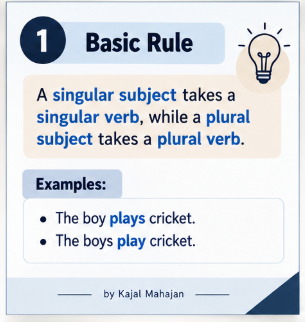
A singular subject usually takes a singular verb, while a plural subject usually takes a plural verb.
For example:
- The boy plays cricket.
- The boys play cricket.
Subject–Verb Agreement may look simple, but many questions contain tricky rules. Words such as each, every, either, neither, everyone, along with, as well as, a number of, the number of, and either…or can easily cause mistakes.
SUBJECT VERB AGREEMENT RULES
| SUBJECT VERB AGREEMENT RULE | EXAMPLES |
| 1. A singular subject takes a singular verb, while a plural subject takes a plural verb. | The boy plays cricket. / The boys play cricket. |
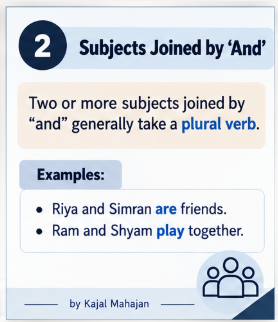
| 2. Two or more subjects joined by “and” generally take a plural verb. | Ram and Shyam are friends. |
| 3. If two nouns joined by “and” refer to the same person, thing, or idea, use a singular verb. | Bread and butter is my breakfast. / The poet and philosopher is here. |
| 4. “Each” and “every” take a singular verb. This remains true when they are followed by “of + plural noun”. | Each student has a book. / Each of the boys is ready. / Every child needs care. |
| 5. “Either” and “neither” used alone take a singular verb. | Either of the answers is correct. / Neither of the boys is absent. |
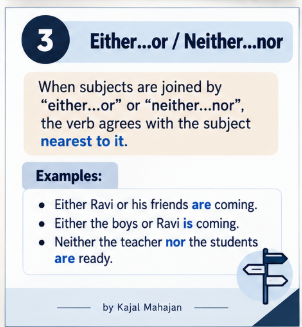
| 6. “Either…or”, “neither…nor” and “not only…but also” take a verb according to the subject nearest to the verb. | Either the teacher or the students are responsible. / Either the students or the teacher is responsible. |
| 7. “Along with, together with, as well as, with, including, besides, accompanied by, rather than, etc.” do not change the number of the main subject. | The teacher, along with the students, is present. / Riya as well as her sisters has arrived. |
| 8. A phrase between the subject and verb does not affect subject–verb agreement. | The quality of these apples is good. / The students in this class are intelligent. |
| 9. “One of + plural noun” takes a singular verb. | One of the boys is absent. |
| 10. “Many a + singular noun” takes a singular verb. | Many a student has made this mistake. |
| 11. “More than one + singular noun” generally takes a singular verb. | More than one student has complained. |
| 12. “A number of + plural noun” takes a plural verb, whereas “the number of + plural noun” takes a singular verb. | A number of students are absent. / The number of students is increasing. |
| 13. Collective nouns take a singular verb when the group acts as one unit; they may take a plural verb when individual members are emphasised. | The team is winning. / The committee are divided in their opinions. |
| 14. Words such as “everyone, everybody, everything, someone, somebody, something, anyone, anybody, anything, no one, nobody, nothing” take singular verbs. | Everyone is ready. / Somebody has called. / Nothing is impossible. |
| 15. “Both, many, few, a few, several” take plural verbs. | Both are correct. / Several students have arrived. |
| 16. “Much, little, a little” take singular verbs when they refer to uncountable nouns. | Much of the work is complete. / Little water is left. |
| 17. Expressions such as “some of, all of, most of, half of, plenty of, a lot of, lots of, the rest of” take a verb according to the noun following “of”. | Some of the students are absent. / Some of the milk is left. |
| 18. Fractions and percentages take a verb according to the noun following “of”. | Two-thirds of the students are present. / Two-thirds of the work is complete. |
| 19. “There is/are” and “Here is/are” agree with the actual subject that follows the verb. | There is a book. / There are five books. / Here is your pen. |
| 20. Relative pronouns “who, which, that” take the number of their antecedent. | The boy who works hard succeeds. / The boys who work hard succeed. |
| 21. In “one of those who…”, the verb in the relative clause is generally plural because “who” refers to “those”. | She is one of those students who work hard. |
| 22. In “the only one of those who…”, use a singular verb because “who” refers to “the only one”. | She is the only one of the students who works hard. |
| 23. Gerunds, infinitives and clauses used as subjects generally take singular verbs. | Swimming is good exercise. / To err is human. / What he says is true. |
| 24. When two activities are treated as one idea, use a singular verb; when they are separate activities, use a plural verb. | Bread and butter is my breakfast. / Walking and swimming are different activities. |
| 25. Titles of books, newspapers, films, plays, etc. take singular verbs even if the title looks plural. | The Arabian Nights is a famous book. / Gulliver’s Travels is interesting. |
| 26. Subjects ending in “-ics”, such as mathematics, physics, economics, politics, etc., generally take singular verbs when referring to a subject/field. | Mathematics is difficult. / Economics is interesting. |
| 27. “News” takes a singular verb. | The news is shocking. |
| 28. Some nouns ending in “-s” are singular in meaning and take singular verbs. | Mathematics is difficult. / Measles is contagious. |
| 29. Nouns that are always plural, such as police, cattle, people, generally take plural verbs. | The police are investigating. / The cattle are grazing. |
| 30. Pair nouns such as scissors, trousers, spectacles, shoes, etc. take plural verbs when used alone; “a pair of” takes a singular verb. | The scissors are sharp. / A pair of scissors is on the table. |
| 31. Uncountable nouns such as advice, information, furniture, luggage, equipment, scenery, etc. take singular verbs. | The furniture is expensive. / The information is useful. |
| 32. “Kind/type/sort/variety” agrees according to the actual subject. | This kind of book is useful. / These kinds of books are useful. |
| 33. “A variety of” generally takes a plural verb, while “the variety of” takes a singular verb. | A variety of books are available. / The variety of books is impressive. |
| 34. “Majority/minority” can take a singular or plural verb depending on whether the group is treated as one unit or as individuals. | The majority is in favour. / The majority of students are present. |
| 35. Amounts of money, periods of time, distances and measurements take a singular verb when regarded as one unit. | Ten thousand rupees is a large amount. / Ten years is a long time. / Ten kilometres is a long distance. |
| 36. “No” takes a singular or plural verb according to the noun following it. | No student is absent. / No students are absent. |
| 37. “Less” is generally used with uncountable nouns and takes a singular verb; “fewer” is used with plural countable nouns and takes a plural verb. | Less water is required. / Fewer students are absent. |
| 38. “The + adjective” referring to a group of people takes a plural verb. | The rich are not always happy. / The poor need help. |
| 39. “People” takes a plural verb, while “person” takes a singular verb. | One person is waiting. / Many people are waiting. |
| 40. In questions and inverted sentences, identify the real subject before choosing the verb. | Where is the boy? / Where are the boys? / Behind the house is a garden. |
TRAPS FOR EXAMS- SUBJECT VERB AGREEMENT RULES TO FOLLOW
| Expression | Verb |
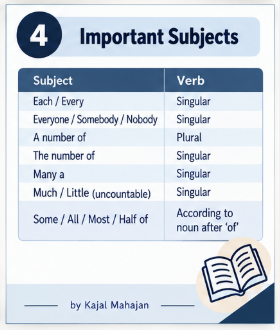
| Each / Every | Singular |
| Either / Neither | Singular |
| Everyone / Everybody / Someone / Nobody | Singular |
| One of + plural noun | Singular |
| Many a + singular noun | Singular |
| More than one | Singular |
| A number of | Plural |
| The number of | Singular |
| Both / Many / Few / Several | Plural |
| Either…or / Neither…nor | Nearest subject |
| Not only…but also | Nearest subject |
| Along with / as well as / together with | First/main subject |
| A pair of | Singular |
| Police / cattle / people | Plural |
| News / mathematics / physics | Singular |
| Time/money/distance as one unit | Singular |
| Fractions / percentages | According to noun after of |
| Some/all/most/half of | According to noun after of |
| There is/are | According to following subject |
| Who/which/that | According to antecedent |