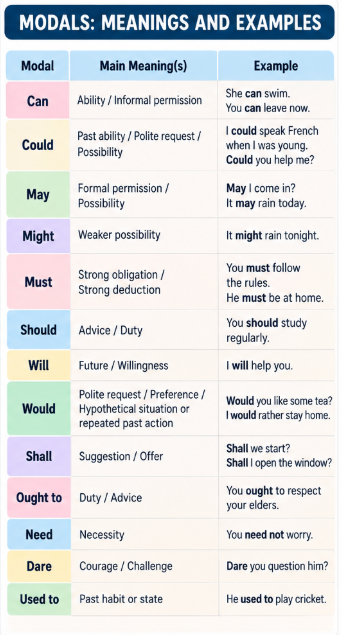
MEANING OF MODALS
Modals are helping verbs that show the attitude, possibility, ability, permission, necessity, obligation, advice, or intention of the speaker.
| Rule / Structure of Modals | Example |
| A modal is always followed by the base form (V1) of the verb. | She can swim. |
| Modal + V1 | You should study. |
| A modal does not take -s/-es with the subject. | He can drive. (Correct) He cans drive. (Incorrect) |
| Two modals generally do not occur together. | He may have to go. (Correct) He may must go. (Incorrect) |
| To form a negative, use modal + not + V1. | You should not waste time. |
| To form a question, put the modal before the subject. | Can you help me? |
| Modals express ideas such as ability, possibility, permission, obligation, necessity, advice, prediction, willingness, etc. | You must obey the rules. |
| Modal / Expression | Difference / When to Use | Example |
| Can vs Could | Can = present ability; Could = past ability | I can swim. / I could swim when I was five. |
| Can vs May | Can = informal permission; May = formal permission | Can I come in? / May I come in, Sir? |
| May vs Might | May = greater possibility; Might = weaker possibility | He may come today. / He might come today. |
| Can vs Could | Can = direct request; Could = more polite request | Can you help me? / Could you help me? |
| Will vs Would | Will = future/willingness; Would = polite request, preference or imaginary situation | I will help you. / I would help you if I could. |
| Shall vs Will | Shall = offer/suggestion, especially with I/we; Will = future, promise or willingness | Shall we go? / I will go tomorrow. |
| Shall vs Should | Shall = offer/suggestion; Should = advice/duty | Shall I help you? / You should help him. |
| Should vs Must | Should = advice/duty; Must = strong obligation/necessity | You should study. / You must submit the form. |
| Should vs Ought to | Both express advice/duty; ought to often has a stronger sense of moral duty | You should respect your parents. / You ought to respect your parents. |
| Must vs Have to | Must = strong obligation felt/imposed by speaker; Have to = external requirement | You must finish this. / I have to wear a uniform. |
| Must vs Need to | Both show necessity; must is stronger | You must see a doctor. / You need to see a doctor. |
| Mustn’t vs Needn’t | Mustn’t = prohibited; Needn’t = unnecessary | You mustn’t smoke. / You needn’t worry. |
| Needn’t vs Don’t have to | Both mean “not necessary” | You needn’t come. / You don’t have to come. |
| Could vs Might | Both express possibility; could often suggests a possible option/event, might emphasizes uncertainty | We could go by train. / It might rain. |
| May vs Can | May = specific possibility; Can = general possibility | It may rain tonight. / Winters can be very cold here. |
| Must vs May/Might | Must = strong conclusion; may/might = uncertain possibility | She must be tired. / She might be tired. |
| Can’t vs Mustn’t | Can’t = impossible / strong negative conclusion; Mustn’t = prohibition | He can’t be serious. / You mustn’t enter. |
| Could have vs Should have | Could have = possibility/opportunity existed; Should have = something was advisable but wasn’t done | You could have won. / You should have studied. |
| Could have vs Might have | Both refer to past possibility; might have stresses uncertainty; could have can also mean an unrealized opportunity | He might have missed the bus. / He could have missed the bus. |
| Must have vs May/Might have | Must have = almost certain past conclusion; may/might have = possible past event | She must have left. / She might have left. |
| Needn’t have vs Didn’t have to | Needn’t have + V3 = action was unnecessary but actually done; didn’t have to = action was unnecessary, usually implying it wasn’t done | You needn’t have bought food. / I didn’t have to buy food. |
| Used to vs Would | Both can describe past habits; used to can describe states too, while would generally describes repeated actions | I used to live in Delhi. / My father would take us there every Sunday. |
| Used to vs Was/Were used to | Used to + V1 = past habit; be used to + noun/gerund = accustomed to something | I used to play cricket. / I am used to playing cricket. |
| Need vs Need to | Need as a modal is mainly used in questions/negatives; need to is a normal verb structure | You needn’t worry. / You need to study. |
| Dare vs Dare to | Dare as a modal takes V1; dare to behaves like a normal verb | He dare not speak. / He dares to speak. |
| Could vs Was able to | Could = general past ability; was/were able to = successful completion of a specific action | I could swim as a child. / I was able to escape. |
QUICK REVISION OF MODALS FOR EXAMS
| If you see… | Remember… |
| Modal + verb | V1 |
| Modal + to | Usually wrong |
| Modal + s/es | Wrong |
| Ought | Ought to + V1 |
| Needn’t | Needn’t + V1 |
| Mustn’t | Prohibition |
| Needn’t | No necessity |
| Should have | V3 |
| Could have | V3 |
| May/Might have | V3 |
| Must have | V3 |
| Used to | V1 |
| Be used to | V-ing/noun |
| Would rather | V1 |
| Had better | V1 |
| Past general ability | Could |
| Specific successful past action | Was/Were able to |
| Formal permission | May |
| Informal permission | Can |
| Weak possibility | Might |
| Strong conclusion | Must |
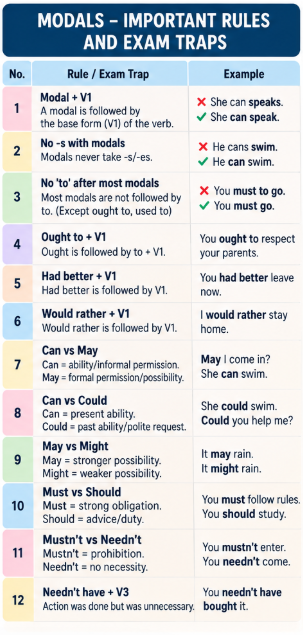
MODALS – EXAM TRAPS
| No. | Exam Trap | Correct Rule of Modals | Example |
| 1 | Modal + verb | A modal is followed by V1. | She can speak English. |
| 2 | Modal + -s | Modals never take -s/-es. | Incorrect: He cans swim. → Correct: He can swim. |
| 3 | Modal + to | Most modals are not followed by to. | Incorrect: You must to go. → Correct: You must go. |
| 4 | Ought to | Ought is followed by to + V1. | You ought to respect your parents. |
| 5 | Had better | Had better + V1, not to + V1. | You had better leave now. |
| 6 | Would rather | Would rather + V1 for the same subject. | I would rather stay home. |
| 7 | Can vs May | Can = ability/informal permission; may = formal permission/possibility. | May I come in? |
| 8 | Can vs Could | Can = present ability; could = past ability/polite request/possibility. | She could swim at five. |
| 9 | May vs Might | Both express possibility; might generally indicates weaker possibility. | It might rain tonight. |
| 10 | Must vs Should | Must = strong obligation; should = advice/duty. | You must obey the law. |
| 11 | Mustn’t | Mustn’t = prohibition, not lack of necessity. | You mustn’t smoke here. |
| 12 | Needn’t | Needn’t = no necessity. | You needn’t come tomorrow. |
| 13 | Needn’t have + V3 | An action was done, but it was unnecessary. | You needn’t have bought it. |
| 14 | Should have + V3 | Past advice/duty that was not followed. | You should have studied. |
| 15 | Could have + V3 | Past possibility/ability that was not used or realised. | She could have won. |
| 16 | May/Might have + V3 | Shows possibility in the past. | He might have missed the bus. |
| 17 | Must have + V3 | Shows a strong deduction about the past. | He must have forgotten. |
| 18 | Modal + have + V3 | For past meanings, use modal + have + past participle. | She should have gone. |
| 19 | Used to | Shows a past habit or past state that is no longer true. | I used to live in Delhi. |
| 20 | Would | Can show a repeated past action, but generally not a past state. | We would play outside. |
| 21 | Shall | Commonly used for suggestions and offers, especially with I/we. | Shall we start? |
| 22 | Will vs Would | Would is commonly used for polite requests and hypothetical situations. | Would you help me? |
| 23 | Dare | As a modal, it can be followed directly by V1; as an ordinary verb, it can take to + V1. | Dare you ask? / He dares to ask. |
| 24 | Modal questions | Do not use do/does/did with a modal. | Incorrect: Does he can swim? → Correct: Can he swim? |
| 25 | Modal negatives | Put not directly after the modal. | She cannot attend. |
| 26 | Can’t vs Must | Can’t can show impossibility; must can show strong logical deduction. | He can’t be serious. / He must be tired. |
| 27 | Mustn’t vs Don’t have to | Mustn’t = prohibited; don’t have to = not necessary. | You mustn’t leave. / You don’t have to leave. |
| 28 | Could vs Was able to | Could is common for general past ability; was able to often describes a specific successful achievement. | She was able to solve the problem. |
| 29 | If-clause + will | In ordinary first conditional sentences, use Simple Present after if. | If he comes, I will meet him. |
| 30 | Modal with he/she/it | The modal remains unchanged with all subjects. | He can swim. She can swim. |
| 31 | Modal + continuous | For an action in progress, use modal + be + V-ing. | He may be sleeping. |
| 32 | Modal + passive | Passive structure: modal + be + V3. | The work must be completed. |
| 33 | Modal + perfect passive | Use modal + have been + V3 for a past passive meaning. | The work should have been completed. |
| 34 | Could not vs Must not | Could not can indicate inability/impossibility; must not indicates prohibition. | He couldn’t enter. / He mustn’t enter. |
| 35 | Should vs Ought to | Both commonly express advice, duty, or expectation. | You should/ought to apologise. |
READ ALSO: DIRECT AND INDIRECT SPEECH RULES