DIRECT AND INDIRECT SPEECH
| What is Direct Speech? | What is Indirect Speech? |
| When we report the exact words spoken by a person, we use Direct Speech. | When we report the meaning of someone’s words without using their exact words, we use Indirect Speech. |
| Example: Riya said, “I am tired.” The exact words spoken by Riya are: “I am tired.” These words are placed inside quotation marks (” “). | Direct: Riya said, “I am tired.” Indirect: Riya said that she was tired. |
| Structure: Reporting Clause + Reporting Verb + Quoted Speech Example: Riya said, “I am tired.” Riya → Speaker said → Reporting verb “I am tired.” → Reported/quoted words | Notice: Quotation marks are removed. I → she am → was that is added. The sentence becomes grammatically connected. |
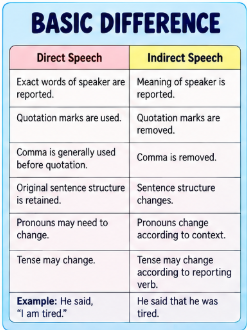
DIRECT VS INDIRECT SPEECH
| Direct Speech | Indirect Speech |
| Exact words are used. | Meaning is reported. |
| Quotation marks are used. | No quotation marks. |
| Comma is generally used before quotation. | Comma is removed. |
| Pronouns may remain unchanged. | Pronouns usually change. |
| Tense may change. | Tense may change according to rules. |
| Example: He said, “I am busy.” | He said that he was busy. |
PARTS OF DIRECT SPEECH
| Part | Meaning | Example |
| Reporting Subject | Person who speaks | Riya said… |
| Reporting Verb | Verb used to report speech | Riya said… |
| Reporting Object | Person spoken to | Riya said to me… |
| Reported Speech | Actual words | “I am tired.” |
Example:
Riya said to me, “I am tired.”
| Element | Answer |
| Reporting Subject | Riya |
| Reporting Verb | Said |
| Reporting Object | Me |
| Reported Speech | I am tired |
Reporting Clause
Reporting Clause consists of Reporting Subject, Reporting Verb and Reporting Object
Rahul said to me
This tells us:
- Who spoke?
- To whom?
- What reporting verb was used?
Reported Speech
“I am going to Delhi tomorrow.”
This contains the actual words spoken.
MOST IMPORTANT BASIC RULES
When changing Direct Speech into Indirect Speech, check these four things:
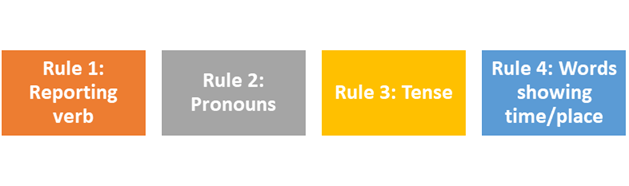
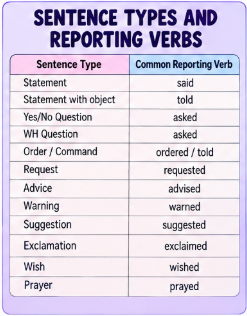
RULE 1: REPORTING VERB
Reporting Verb: Basic Changes
| Direct Speech | Indirect Speech |
| said | said |
| said to | told |
| said to | Asked if the statement is a question |
| said to | Ordered If the statement is a command |
| said to | Requested if the statement is a request |
| said to | Advised if the statement is an advice |
| said to | warned if the statement is a warning |
| said to | suggested if the statement is a suggestion |
| said | exclaimed if the statement is an exclamation |
| said | wished if the statement is a wish |
| said | prayed if the statement is a prayer |
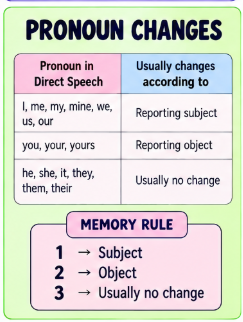
RULE 2: PRONOUNS
| Pronoun in Direct Speech | Usually changes according to |
| First person : I, me, my, mine, we, us, our | Reporting subject |
| Second person : you, your, yours | Reporting object |
| Third person : he, she, it, they, them, their | Usually no change |
Memory Rule:
First Person → According to the SUBJECT of reporting verb
Second Person → According to the OBJECT of reporting verb
Third Person → Usually remains unchanged
Pronoun Examples
| Direct | Indirect |
| Riya said, “I am happy.” | Riya said that she was happy. |
| Riya said to me, “I will help you.” | Riya told me that she would help me. |
| Rahul said to Priya, “You are kind.” | Rahul told Priya that she was kind. |
| They said, “We are ready.” | They said that they were ready. |
| He said, “They are my friends.” | He said that they were his friends. |
Demonstrative Words
| Direct | Indirect |
| this | That |
| these | Those |
| this book | that book |
| these books | those books |
Example:
Direct: “I like this book.”
Indirect: He said that he liked that book.
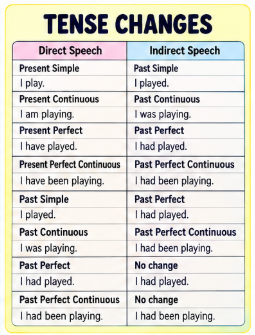
RULE 3: TENSE CHANGES
When the reporting verb is in the past tense, the tense usually moves one step backwards.
| Direct Speech | Indirect Speech |
| Present Simple | Past Simple |
| I play. | I played. |
| Present Continuous | Past Continuous |
| I am playing. | I was playing. |
| Present Perfect | Past Perfect |
| I have played. | I had played. |
| Present Perfect Continuous | Past Perfect Continuous |
| I have been playing. | I had been playing. |
| Past Simple | Past Perfect |
| I played. | I had played. |
| Past Continuous | Past Perfect Continuous |
| I was playing. | I had been playing. |
| Past Perfect | No change |
| I had played. | I had played. |
| Past Perfect Continuous | No change |
| I had been playing. | I had been playing. |
Present Tense Changes
| Direct | Indirect | Example |
| am/is/are | was/were | “I am happy.” → He said that he was happy. |
| V1/V1+s | V2 | “I play.” → He said that he played. |
| am/is/are + V:ing | was/were + V:ing | “I am reading.” → He said that he was reading. |
| has/have + V3 | had + V3 | “I have eaten.” → He said that he had eaten. |
| has/have been + V:ing | had been + V:ing | “I have been working.” → He said that he had been working. |
Past Tense Changes
| Direct | Indirect | Direct | Indirect |
| V2 | had + V3 | “I went.” | He said that he had gone. |
| was/were + V:ing | had been + V:ing | “I was going.” | He said that he had been going. |
| had + V3 | No change | “I had gone.” | He said that he had gone. |
| had been + V:ing | No change | “I had been going.” | He said that he had been going. |
When Tense Does NOT Change
| Situation | Example |
| Reporting verb is present | He says, “I am busy.” → He says that he is busy. |
| Reporting verb is future | He will say, “I am busy.” → He will say that he is busy. |
| Universal truth | He said, “The Earth moves.” → He said that the Earth moves. |
| Past perfect | “I had finished.” → He said that he had finished. |
| Modal already in past form | “I could swim.” → He said that he could swim. |
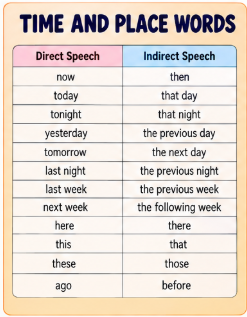
RULE 4: TIME/ PLACE CHANGES
| Direct Speech | Indirect Speech |
| now | then |
| today | that day |
| tonight | that night |
| yesterday | the previous day / the day before |
| tomorrow | the next day / the following day |
| last night | the previous night |
| last week | the previous week |
| last month | the previous month |
| last year | the previous year |
| next week | the following week |
| next month | the following month |
| next year | the following year |
| ago | before |
| here | there |
| this | that |
| these | those |
| thus | so |
| come | go : depending on context |
IMPORTANT TRAP : “TODAY”
Direct:
He said, “I am busy today.”
If reporting is on the same day:
→ He said that he was busy today.
If reporting is on another day:
→ He said that he was busy that day.
So context matters.
Special Time Expressions
| Direct | Indirect |
| the day before yesterday | two days before |
| the day after tomorrow | two days later |
| two days ago | two days before |
| a week ago | a week before |
| last Sunday | the previous Sunday |
| next Sunday | the following Sunday |
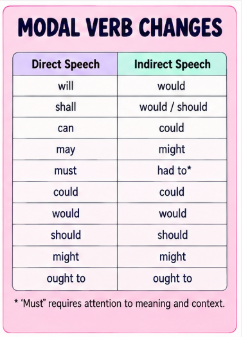
MODAL VERB CHANGES
| Direct | Indirect |
| will | would |
| shall | would/should |
| can | could |
| may | might |
| must | had to* (*Must requires attention to meaning and context). |
| could | could |
| would | would |
| should | should |
| might | might |
| ought to | ought to |
TYPE OF SENTENCES AND REPORTING VERBS USED
Statement Rules
Structure:
Subject + said + that + statement
| Direct | Indirect |
| He said, “I am tired.” | He said that he was tired. |
| She said, “I like music.” | She said that she liked music. |
| They said, “We are ready.” | They said that they were ready. |
“SAID” vs “TOLD”
| Direct | Correct Indirect |
| He said, “I am busy.” | He said that he was busy. |
| He said to me, “I am busy.” | He told me that he was busy. |
| He told me, “I am busy.” | He told me that he was busy. |
| Incorrect: He told that he was busy. | Incorrect |
Golden Rule:
TELL needs an object.
Correct: He told me.
Incorrect: He told.
QUESTIONS: MASTER TABLE
| Question Type | Connector | Example |
| Yes/No question | if/whether | He asked if I was ready. |
| What question | what | He asked what I wanted. |
| Why question | why | He asked why I was late. |
| Where question | where | He asked where I lived. |
| When question | when | He asked when I would come. |
| Who question | who | He asked who had called. |
| Which question | which | He asked which book I wanted. |
| How question | how | He asked how I had solved it. |
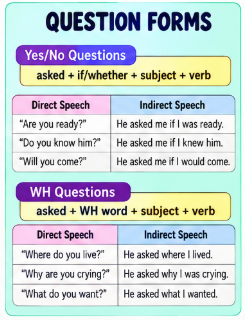
Yes/No Questions
Formula:
asked + object + if/whether + subject + verb
| Direct | Indirect |
| “Are you ready?” | He asked me if I was ready. |
| “Do you know him?” | He asked me if I knew him. |
| “Can you swim?” | He asked me if I could swim. |
| “Will you come?” | He asked me if I would come. |
| “Have you finished?” | He asked me if I had finished. |
WH Questions
Formula:
asked + object + WH word + subject + verb
| Direct | Indirect |
| “Where do you live?” | He asked where I lived. |
| “Why are you crying?” | He asked why I was crying. |
| “When will you come?” | He asked when I would come. |
| “What are you doing?” | He asked what I was doing. |
| “How did you solve it?” | He asked how I had solved it. |
Question Word Order: BIG EXAM TRAP
| Direct Question | Incorrect Indirect | Correct Indirect |
| Where are you going? | Incorrect: where was I going? | Correct: where I was going |
| Why are you crying? | Incorrect: why was I crying? | Correct: why I was crying |
| What do you want? | Incorrect: what did I want? | Correct: what I wanted |
| When will you come? | Incorrect: when would I come?* | Correct: when I would come |
*The issue is not the modal itself; the problem is maintaining question word order.
Golden Rule:
Indirect question = Statement word order
Command / Order
Formula:
ordered/told + object + to + V1
| Direct | Indirect |
| “Open the door.” | He told me to open the door. |
| “Sit down.” | He ordered me to sit down. |
| “Work hard.” | He advised me to work hard. |
| “Follow me.” | He told me to follow him. |
Negative Commands
Formula:
reporting verb + object + not to + V1
| Direct | Indirect |
| “Do not run.” | He told me not to run. |
| “Don’t shout.” | He told me not to shout. |
| “Never lie.” | He advised me never to lie. |
| “Don’t touch it.” | He warned me not to touch it. |
Request
| Direct Expression | Indirect Reporting Verb |
| Please… | requested |
| Kindly… | requested |
| Please help me. | requested me to help him. |
| Please wait. | requested me to wait. |
| Please give me some water. | requested me to give him some water. |
Advice
| Direct | Indirect |
| “Work hard.” | He advised me to work hard. |
| “Take rest.” | The doctor advised me to take rest. |
| “Eat healthy food.” | The doctor advised me to eat healthy food. |
| “Do not smoke.” | The doctor advised him not to smoke. |
Warning
| Direct | Indirect |
| “Don’t touch the wire.” | He warned me not to touch the wire. |
| “Don’t go there.” | He warned me not to go there. |
| “Be careful.” | He warned me to be careful. |
Suggestion
| Direct | Indirect |
| “Let us go.” | He suggested that we should go. |
| “Let’s play.” | He suggested that they should play. |
| “Let us help him.” | He suggested that they should help him. |
| “Why don’t we go?” | He suggested that they should go. |
Alternative:
suggested + V:ing
He suggested going to the park.
Avoid in school exams:
Incorrect: He suggested me to go.
SENTENCES STARTING FROM: “LET”
| Direct “Let” Meaning | Indirect Structure |
| Let us = suggestion | suggested that…should |
| Let me = request/permission | requested/asked to be allowed |
| Let him = permission/allowing | allowed him to… / said that he should be allowed |
| Let them = permission | allowed them to… |
Examples:
| Direct | Indirect |
| “Let us go.” | He suggested that they should go. |
| “Let me go.” | He requested me to let him go. |
| “Let him come in.” | He said that he should be allowed to come in. |
Exclamatory Sentences
| Emotion | Reporting Verb |
| Happiness | exclaimed with joy |
| Sorrow | exclaimed with sorrow |
| Surprise | exclaimed with surprise |
| Admiration | exclaimed with admiration |
| Regret | exclaimed with regret |
| Anger | exclaimed with anger |
Exclamation Words
| Direct Word | Meaning |
| Hurrah! | Joy |
| Alas! | Sorrow |
| Wow! | Surprise/admiration |
| Oh! | Surprise/sorrow depending on context |
| Ah! | Satisfaction/surprise depending on context |
| Bravo! | Appreciation/admiration |
Exclamation Examples
| Direct | Indirect |
| “Hurrah! We won!” | He exclaimed with joy that they had won. |
| “Alas! He is dead!” | He exclaimed with sorrow that he was dead. |
| “What a beautiful painting!” | He exclaimed with admiration that it was a very beautiful painting. |
| “How foolish I have been!” | He exclaimed with regret that he had been very foolish. |
Optative Sentences
These express a wish, prayer, blessing, or curse.
| Meaning | Reporting Verb |
| Wish | wished |
| Prayer | prayed |
| Blessing | blessed |
| Curse | cursed |
Examples:
| Direct | Indirect |
| “May you succeed!” | He wished that I might succeed. |
| “May God bless you!” | He prayed that God might bless me. |
| “May you live long!” | He wished that I might live long. |
Special Expressions
| Direct Expression | Indirect |
| Thank you. | thanked |
| Congratulations! | congratulated |
| Sorry. | apologised |
| Good morning. | wished/greeted |
| Good evening. | wished/greeted |
| Welcome! | welcomed |
| Bravo! | applauded/congratulated |
| Yes. | agreed |
| No. | refused/denied : depending on context |
Promise, Offer, Threat, Refusal
| Direct Meaning | Reporting Verb | Example |
| Promise | promised | He promised to help me. |
| Offer | offered | He offered to help me. |
| Threat | threatened | He threatened to punish me. |
| Refusal | refused | He refused to help me. |
| Agreement | agreed | He agreed to help me. |
Universal Truth
When the statement is a universal truth/general scientific fact, tense generally does not change.
| Direct | Correct Indirect |
| “The Earth revolves around the Sun.” | He said that the Earth revolves around the Sun. |
| “The Sun rises in the east.” | He said that the Sun rises in the east. |
| “Water boils at 100°C.” | He said that water boils at 100°C. |
| “Two and two make four.” | He said that two and two make four. |
The “Do/Does/Did” Trap
In indirect questions, do/does/did usually disappear.
| Direct | Indirect |
| Where do you live? | He asked where I lived. |
| What does she want? | He asked what she wanted. |
| Why did he leave? | He asked why he had left. |
| Do you know him? | He asked if I knew him. |
| Did you see him? | He asked if I had seen him. |
Negative Questions
Direct:
He said to me, “Don’t you know him?”
Indirect:
He asked me if I did not know him.
Depending on context, the negative meaning must be preserved.
Questions Beginning with “Shall”
These require attention to meaning.
| Direct | Possible Indirect |
| “Shall I open the door?” | He asked if he should open the door. |
| “Shall we go?” | He asked if they should go. |
| “Shall I help you?” | He offered to help me / asked whether he should help me. |
“Would You…” : Usually a Request
Direct:
He said to me, “Would you help me?”
Indirect:
He asked me to help him.
Depending on context:
He asked me whether I would help him.
“Could You…” : Request
Direct:
She said to me, “Could you open the door?”
Indirect:
She requested me to open the door.
“Why Don’t You…” : Context Matters
It can express:
- suggestion
- criticism
- question
Example:
“Why don’t you take a break?”
→ He suggested that I should take a break.
“Must” : Exam Table
| Meaning of MUST | Possible Indirect Form |
| Obligation | had to |
| Necessity | had to |
| Strong rule | had to |
| Logical conclusion | may remain must |
| General/permanent necessity | may remain must |
Example:
“I must finish this work.”
→ He said that he had to finish that work.
MOST COMMON EXAM TRAPS
| Trap | Wrong | Correct |
| Told without object | He told that… | He told me that… |
| Question order | why was I late | why I was late |
| Question + that | asked that where | asked where |
| Yes/No question | asked that | asked if/whether |
| Negative command | told me don’t go | told me not to go |
| Suggestion | suggested me to go | suggested that I should go |
| Question mark | He asked if I was ready? | He asked if I was ready. |
| Universal truth | Earth revolved | Earth revolves |
| Present reporting verb | says…was | says…is |
| “Please” retained | requested me please | requested me |
| Quotation marks | He said “that…” | He said that… |
| “said to” for question | told me if | asked me if |
| “said to” for command | said to me to go | told me to go |
THE EASIEST WAY TO REMEMBER EVERYTHING
Think of Direct → Indirect as:
TYPE → VERB → PRONOUN → TENSE → TIME/PLACE → STRUCTURE
For example:
Rahul said to me, “Will you come here tomorrow?”
TYPE
Question.
VERB
said to → asked
PRONOUN
you → I
TENSE
will → would
PLACE
here → there
TIME
tomorrow → the next day
STRUCTURE
Yes/No question → if
Final:
Rahul asked me if I would go there the next day.
That is the complete thought process you should use in an examination.