WHAT IS COMPANY

Meaning of Company
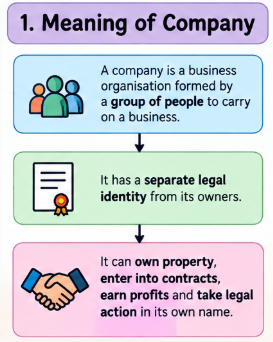
A company is a business organisation formed by a group of people to carry on a business. It has a separate legal identity from its owners. It can own property, enter into contracts, earn profits, and take legal action in its own name.
FEATURES OF COMPANY
1. Separate Legal Entity
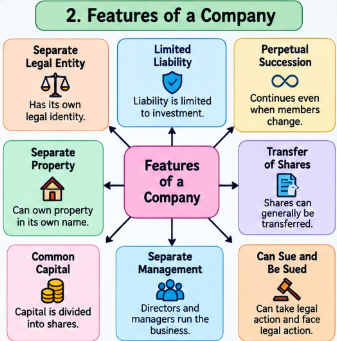
A company has a legal identity of its own.It is separate from its shareholders and owners. The company can own property and make contracts in its own name.
2. Limited Liability
The liability of shareholders is usually limited to the amount they have invested. Their personal property is normally not used to pay company debts. This reduces the financial risk of shareholders.
3. Perpetual Succession
A company continues to exist even when its members change. The death or retirement of a shareholder does not normally end the company. Therefore, the company can continue its business for a long time.
4. Separate Property
A company can own land, buildings, machines and other assets. These assets belong to the company and not directly to its shareholders. The company can use these assets for carrying out its business.
5. Transfer of Shares
The ownership of a company is divided into shares. Shares can generally be transferred from one person to another, depending on the type of company. This makes it easier for investors to buy or sell their ownership.
6. Common Capital
The capital of a company is divided into small units called shares. People can purchase these shares and become shareholders. This helps the company collect a large amount of money.
7. Separate Management
The shareholders are the owners of the company. The directors and managers usually take care of the daily business activities. This allows professional people to manage the business.
8. Can Sue and Be Sued
A company can take legal action against another person or organisation. Similarly, other people or organisations can take legal action against the company. The company is treated as a separate legal person for this purpose.
ADVANTAGES OF COMPANY
1. Limited Liability
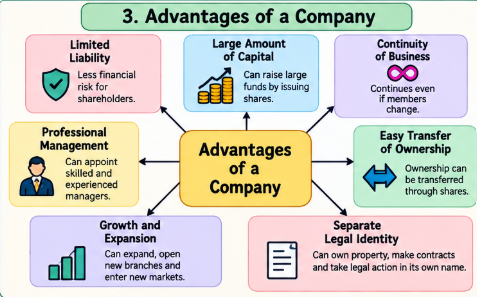
Shareholders usually have limited financial responsibility. They normally do not have to use their personal property to pay company debts. This makes investment in a company less risky.
2. Large Amount of Capital
A company can raise a large amount of money by issuing shares. It can collect money from many investors. This money can be used to start, operate and expand the business.
3. Continuity of Business
A company has a continuous existence. It does not normally end because a shareholder dies or leaves the company. This provides stability to the business.
4. Professional Management
A company can appoint qualified and experienced managers. These managers can use their knowledge to run the business. Professional management can help the company grow and improve its performance.
5. Easy Transfer of Ownership
Ownership can generally be transferred through the sale or transfer of shares. An investor can sell shares without closing the whole business. This provides flexibility to shareholders.
6. Growth and Expansion
A company can raise large amounts of capital for expansion. It can open new branches, purchase machines and enter new markets. Therefore, companies have good opportunities for business growth.
7. Separate Legal Identity
The company is legally separate from its owners. It can own property, enter into contracts and borrow money in its own name. This gives the business an independent legal status.
DISADVANTAGES OF COMPANY
1. Difficult to Form
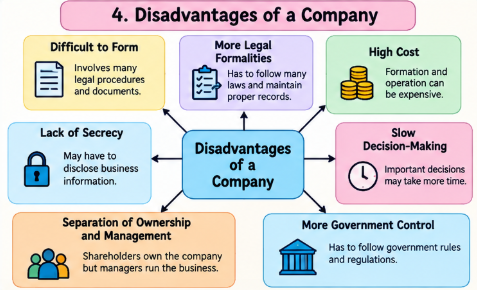
The formation of a company involves several legal procedures. Many documents and formalities have to be completed. Therefore, forming a company can take more time than starting a small business.
2. More Legal Formalities
A company has to follow many laws and government rules. It has to maintain proper records and prepare different reports. These formalities can increase the workload of the business.
3. High Cost
The formation and operation of a company can be expensive. Money may be spent on registration, accounting, legal services and other requirements. Small businesses may find these costs difficult to manage.
4. Lack of Secrecy
Companies may have to provide certain business information to the government and shareholders. Some financial information may also have to be disclosed publicly. Therefore, complete business secrecy is difficult.
5. Slow Decision-Making
Important decisions may require approval from directors or shareholders. Different levels of management may need to be consulted. As a result, some decisions may take more time.
6. Separation of Ownership and Management
The shareholders own the company, but managers usually run the business. Sometimes managers may have different interests from the shareholders. This can create problems between owners and management.
7. More Government Control
Companies have to follow various government rules and regulations. Government authorities may require regular reports and documents. Failure to follow the rules can lead to penalties.
CONCLUSION
A company is an important form of business organisation. It provides benefits such as limited liability, large capital, continuous existence, and professional management. However, it also has some disadvantages such as high cost, legal formalities, and less secrecy.