WHAT ARE POETIC DEVICES?
Poetry is very different from regular writing like stories or essays. Every poem has its own special style and layout. Poems are not just random words put together; they follow special patterns that give them shape and meaning.
Poets use special tools called poetic devices to make their words come alive. By using sound patterns, creative comparisons, and special layouts, poets can paint clear pictures in your mind, share deep ideas, and make you feel strong emotions. Knowing these tools helps you find the hidden meanings in a poem.
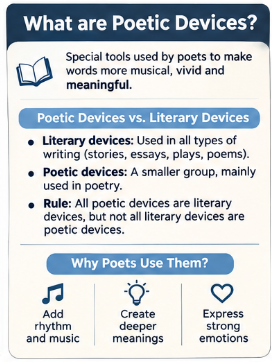
Poetic devices vs. Literary devices:
- Literary devices are tools used in all types of writing (stories, essays, plays, and poems).
- Poetic devices are a smaller group of tools made especially for poetry.
- Easy rule to remember: All poetic devices are literary devices, but not all literary devices are poetic devices.
Why Poets Use Poetic Devices
Poetic devices do much more than just make a poem sound pretty. They make the whole reading experience better:
- Some add a musical beat or rhythm.
- Others add hidden meanings that make you think deeply.
- They help poets express big feelings and ideas that everyday language cannot easily explain.
How to Spot Poetic Devices
Finding poetic devices might seem tricky at first, but it gets much easier with practice. Follow these simple steps:
- Read carefully: Look for patterns in how the words sound, look, or are used.
- Look for clues: Notice any repeated words, rhyming words, or unusual word choices.
- Check your feelings: Pay attention to how the poem makes you feel and notice which words caused that feeling.
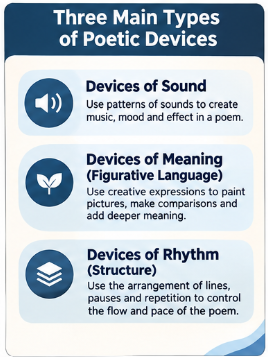
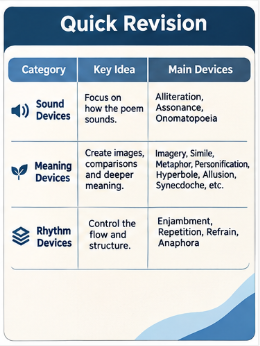
Learning these tricks will help you understand the deeper message and emotional power behind a poet’s words. Because there are too many poetic devices to list all at once, it helps to group the most common ones into three main types:

POETIC DEVICES OF SOUND
Words or parts of words can be placed together or side by side to create certain effects when we hear them. Some sounds may seem soothing or pleasant, while others might be harsh or unpleasant. These planned word arrangements are the poetic devices of sound, which help shape how a poem feels when read aloud.
1. Alliteration (The Tongue-Twister Device)
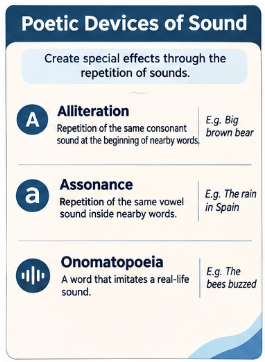
Alliteration happens when words placed close together in a line start with the same consonant sound (any letter except A, E, I, O, U). Poets use it to create a musical beat, make lines catchy, or draw the reader’s attention to important words.
- Important Rule: Always judge by the sound, not the spelling. For example, “Kitchen King” is alliteration (both make the K sound), while “Cute Cat” is alliteration, and “City Cat” is not (because City starts with an S sound and Cat starts with a K sound).
- Examples from Poems:
- “Belinda is as brave as a barrel full of bears” – Repetition of the “b” sound. (The Tale of Custard the Dragon)
- “Stop that slouching and sit up straight” – Repetition of the “s” sound. (Amanda!)
- “Has given my heart” – Repetition of the “h” sound. (Dust of Snow)
2. Assonance (The Vowel Echo Device)
Assonance is the repetition of the same vowel sound (A, E, I, O, U) inside words that are close to each other. Unlike alliteration, which only happens at the start of words, assonance can happen at the beginning, middle, or end of words-as long as the vowel sound echoes across the line. Poets use it to set the mood (long vowels like “oo” or “oh” feel slow and sad, while short vowels like “i” or “e” feel fast and energetic).
- Important Rule: The words do not need to rhyme at the end; only the vowel sound inside needs to match.
- Examples from Poems:
- “Shook down on me” – Repetition of the prominent “o” sound. (Dust of Snow)
- “He stalks in his vivid stripes” – Repetition of the “i” sound in in, his, vivid. (A Tiger in the Zoo)
- “I hold with those who favor fire” – Repetition of the “o” sound. (Fire and Ice)
3. Onomatopoeia (The Sound-Effect Device)
Onomatopoeia (pronounced on-uh-mat-uh-PEE-uh) is when a poet uses a word that imitates the real-life natural sound of an object, animal, or action. When you read the word aloud, it sounds just like the noise itself. Poets use it to bring a scene to life so the reader can “hear” what is happening in the poem.
- Important Rule: Look for action noises, animal sounds, water sounds, or collision sounds (like bang, crash, splash, buzz, whisper, hiss, roar).
- Examples from Poems:
- “Meow, meow“ and “Weeck“ – Animal sounds made by Ink, Blink, and Mustard. (The Tale of Custard the Dragon)
- “He snarls around houses” – The word snarls imitates the angry growl of a tiger. (A Tiger in the Zoo)
- “The chatter of the brook” or “Buzz of bees” – Words that copy nature’s exact sounds.
| Poetic Device | What Repeats? | Where Does It Happen? | Memory Trick / Shortcut | Quick Test Example |
| Alliteration | Same Consonant Sound (B, C, D, F, S, T…) | Beginning of nearby words | Alliteration = At the start (like a tongue twister) | Big brown bear (Repeats “B” at the start) |
| Assonance | Same Vowel Sound (A, E, I, O, U) | Anywhere inside nearby words (start, middle, or end) | Assonance starts with A (a vowel) = Vowel echo inside words | The rain in Spain stays mainly (Repeats long “A” sound inside) |
| Onomatopoeia | Real-life Sound Words (noises) | Any single word that copies a sound | Imagine a comic book sound bubble (BOOM! SPLASH! BUZZ!) | The bees buzzed and the snake hissed (Words copy real noises) |
POETIC DEVICES OF MEANING
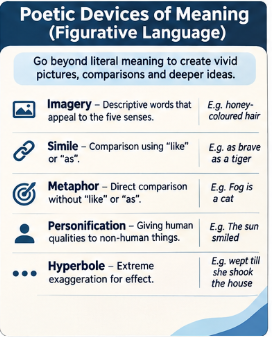
Poetic devices of meaning (also called figurative language or semantic devices) are creative tools poets use to go beyond the literal dictionary definition of words-helping them paint vivid pictures, make clever comparisons, express deep emotions, and add hidden layers of meaning to a poem.
While sound devices (like rhyme and alliteration) focus on how a poem sounds to your ears, poetic devices of meaning focus on what the words make you picture, think, and feel.
1. Imagery
Using descriptive words that appeal to our five senses (sight, sound, smell, taste, touch) so the reader can picture, hear, or feel the scene clearly in their mind.
- Example: “By those great honey-coloured / Ramparts at your ear” – Creates a vivid visual image of Anne’s yellow hair framing her face. (For Anne Gregory)
- Trick / Rule: Ask yourself: “Can I see, hear, smell, taste, or touch this?” If the words paint a movie scene in your head, it is Imagery.
2. Simile
Comparing two completely different things that share one common quality, using the words “like” or “as”.
- Example: “Mustard was as brave as a tiger in a rage” – Compares the dog Mustard to an angry tiger using “as”. (The Tale of Custard the Dragon)
- Trick / Rule: Look for the magic words “like” or “as”. (Warning: “I like apples” is NOT a simile-there must be a comparison between two different things!)
3. Metaphor
A direct comparison between two unrelated things without using “like” or “as.” Instead of saying X is like Y, it says X is Y.
- Example: “The fog comes on little cat feet” – Directly compares fog to a silent cat without using “like” or “as.” (Fog)
- Trick / Rule: Remove “like” or “as” from a simile, and it becomes a metaphor (e.g., “He is as brave as a lion” = Simile; “He is a lion” = Metaphor).
4. Personification
Giving human qualities, feelings, or actions to non-human things (animals, objects, nature, or ideas).
- Example: “No sun bury its feet in shadow” – The sun is given human “feet.” (The Trees)
- Trick / Rule: Look at the word PERSON inside PERSONification. If a tree “whispers,” the wind “cries,” or the sun “smiles,” it’s acting like a person!
5. Hyperbole
Extreme, deliberate exaggeration used to emphasize a strong feeling or create humor-never meant to be taken literally.
- Example: “Belinda wept till she shook the house” – Nobody can cry hard enough to literally shake a building. (The Tale of Custard the Dragon)
- Trick / Rule: Think of HYPER = too much! If a statement is physically impossible because it is blown out of proportion (e.g., “I’ve told you a million times”), it is Hyperbole.
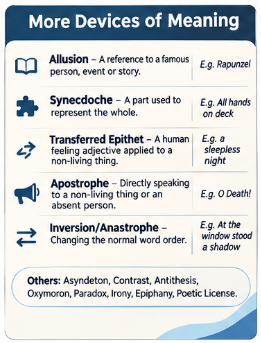
6. Allusion
A quick, indirect reference to a famous person, historical event, myth, religion, or another book/story that the poet expects the reader to recognize.
- Example: “Rapunzel, I have not a care” – Refers to the famous fairy-tale character Rapunzel locked in a tower. (Amanda!)
- Trick / Rule: Think of Allusion = Shout-out. When a poet drops a famous name (like Hercules, Romeo, Cinderella, or Titanic) to make a point without explaining who they are, it’s an Allusion.
7. Synecdoche
Using a part of something to represent the whole thing (or using the whole to represent a part).
- Example: “Has given my heart / A change of mood” – Here, “heart” (a part) represents the poet’s entire self/mind. (Dust of Snow) Another classic example: “All hands on deck” (“hands” = whole sailors).
- Trick / Rule: Part = Whole. If a body part or object piece stands for the entire person or thing (like “nice wheels” for a whole car), it is Synecdoche.
8. Transferred Epithet
An adjective (epithet) is moved from the person who actually feels the emotion and placed next to a non-living object or time.
- Example: “He had a sleepless night” or “They walked down the lonely street” – A night cannot sleep, and a street cannot feel lonely; the person is sleepless or lonely.
- Trick / Rule: Check the adjective! Can that object actually feel that emotion? If you see “angry letter,” “happy morning,” or “cruel bars,” the human emotion has been “transferred” to the object.
9. Apostrophe
When a speaker directly talks to someone who is dead/absent, or speaks to a non-living object or abstract idea as if it can hear and reply.
- Example: “O Death, where is thy sting?” or “Twinkle, twinkle, little star, how I wonder what you are!”
- Trick / Rule: Look for “O” or direct address (using “you”) spoken to nature, an object, or an absent person. (Do not confuse this with the punctuation mark ‘!)
10. Inversion/Anastrophe
Both terms refer to changing the normal word order of a sentence (usually Subject + Verb + Object) to create rhyme, rhythm, or emphasis.
- Inversion is the broad term for flipping normal grammar order (especially putting the verb before the subject, like “Up went the balloon”).
- Anastrophe is a specific type of inversion where single words (like an adjective and noun) are swapped for poetic effect (like “forest primeval” instead of “primeval forest”).
- Example: “The way a crow / Shook down on me” or “At the window stood a shadow” (instead of “A shadow stood at the window”).
- Trick / Rule: Think of Yoda from Star Wars (“Strong with the Force, you are”). Whenever a line sounds backwards compared to normal English grammar, it is Inversion / Anastrophe.
11. Asyndeton
Deliberately leaving out conjunctions (like and, or, but) between a list of words or phrases to make the sentence feel fast, urgent, or dramatic.
- Example: “I came, I saw, I conquered” (instead of “I came, I saw, and I conquered”).
- Trick / Rule: “A-” means WITHOUT + syndeton = connectors. Look for a rapid list separated only by commas with no “and” before the last item.
12. Contrast
Placing two very different ideas, characters, or images side by side anywhere in a poem to highlight how different they are.
- Example: In A Tiger in the Zoo, the poet contrasts the tiger’s helpless life in a concrete cell with his powerful life in the wild jungle.
- Trick / Rule: Look at the big picture-if two stanzas or scenes show complete opposites (light vs. dark, freedom vs. captivity), that is Contrast.
13. Antithesis
Putting two opposite ideas together in the exact same sentence using a balanced, parallel structure.
- Example: “Some say the world will end in fire, / Some say in ice.” (Fire and Ice) – Also: “Speech is silver, but silence is gold.”
- Trick / Rule: Anti = Opposite. Look for two opposites sitting on opposite sides of the same line/sentence like a seesaw (hot/cold, love/hate, fire/ice).
14. Oxymoron
Placing two directly opposite words right next to each other to create a clever or dramatic phrase.
- Example: “Quiet rage” (A Tiger in the Zoo), “bitter sweet,” “living dead,” “open secret,” “deafening silence.”
- Trick / Rule: Oxymoron = 2 opposite words side-by-side. Remember the joke: the word oxy (sharp) + moron (dull) is itself an oxymoron!
15. Paradox
A complete statement or idea that sounds impossible or self-contradictory at first, yet holds a deep truth when you think about it.
- Example: “You have to spend money to make money” or “The child is the father of the man.”
- Trick / Rule: If a whole sentence sounds like a riddle that contradicts itself-but actually makes wise sense-it is a Paradox.
16. Irony
When there is a sharp difference between what is expected/said and what actually happens/is meant.
- Example: In The Tale of Custard the Dragon, everyone boasts about how brave they are while calling Custard a coward-yet when a pirate attacks, all the “brave” pets run away, and “cowardly” Custard saves them!
- Trick / Rule: Irony = The Opposite of Expectations (like a fire station burning down, or a pilot being afraid of heights).
17. Epiphany
A sudden “Aha!” moment of deep realization or truth where a character or speaker suddenly understands something important.
- Example: In The Ball Poem, the boy watches his ball bounce into the water and suddenly realizes the harsh truth of growing up-that loss is a part of life and he must learn to bear it.
- Trick / Rule: Epiphany = Lightbulb moment. Look for a turning point where the poet’s mood or understanding suddenly changes.
18. Poetic License
The special freedom poets have to break normal rules of spelling, grammar, punctuation, or facts to make a rhyme work or create a stronger artistic effect.
- Example: In The Tale of Custard the Dragon, Ogden Nash spells “realio, trulio” instead of “really, truly” and “winda” instead of “window” so it rhymes with Belinda.
- Trick / Rule: License = Permission slip. Whenever a poet intentionally misspells a word or breaks a grammar rule on purpose to fit a rhyme or beat, they are using their Poetic License!
| Confusing Pair | Key Difference | Easy Shortcut | Side-by-Side Example |
| Simile vs. Metaphor | Simile uses “like” or “as”; Metaphor makes a direct statement without them. | Simile = Indirect (like/as) Metaphor = Direct (is/was) | Simile: He fought like a lion. Metaphor: He was a lion in battle. |
| Oxymoron vs. Paradox | Oxymoron is just two opposite words together; Paradox is a full contradictory sentence/idea. | Oxymoron = 2 words Paradox = Full sentence/idea | Oxymoron: Deafening silence Paradox: The more you learn, the less you know. |
| Antithesis vs. Contrast | Antithesis puts opposites inside one balanced line; Contrast compares opposites across larger sections/themes. | Antithesis = Single line seesaw Contrast = Whole poem/stanza comparison | Antithesis: To err is human; to forgive, divine. Contrast: Stanza 1 shows a happy summer; Stanza 2 shows a gloomy winter. |
| Personification vs. Apostrophe | Personification describes an object doing human actions; Apostrophe means talking directly to that object/absent person. | Personification = Talking about an object like a person Apostrophe = Talking to an object | Personification: The wind whispered secrets. Apostrophe: “O Wind, why do you blow so hard?” |
| Personification vs. Transferred Epithet | Personification gives an object a human action; Transferred Epithet shifts a human feeling adjective onto a noun. | Personification = Human verb/action Transferred Epithet = Human adjective moved to a thing | Personification: The night refused to let me sleep. Transferred Epithet: I had a sleepless night. |
| Inversion vs. Anastrophe | Inversion is the general flipping of normal grammar order (often verb before subject); Anastrophe is swapping specific words (like noun + adjective) for poetic style. | Inversion = Broad grammar flip Anastrophe = Specific word swap | Inversion: Into the valley rode the soldiers. Anastrophe: Ocean blue (instead of blue ocean). |
POETIC DEVICES OF RHYTHM
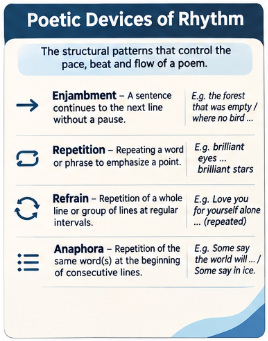
Poetic devices of rhythm are the structural patterns poets use to arrange lines, pauses, and repeated words so a poem flows smoothly like music. While sound devices focus on individual letter sounds and meaning devices focus on imagery and comparisons, rhythm devices control the pace, beat, and structure of how you read a poem aloud.
1. Enjambment (The “Run-On Line” Device)
When a sentence or phrase continues from one line of a poem to the next without a pause or break (no comma, period, or semicolon at the end of the line).Normally, you pause at the end of a line in a poem. With enjambment, the sentence spills over onto the next line without stopping- forcing your eyes to keep moving forward. Poets use this to create speed, tension, or a smooth, continuous flow.
- Examples:
- “the forest that was empty all these days / where no bird could sit / no insect hide / no sun bury its feet in shadow”– One single thought flows continuously across four lines without punctuation breaks at the ends. (The Trees)
- “It sits looking / over harbour and city / on silent haunches”– Mirrors the silent, continuous movement of the fog. (Fog)
- Easy Trick: Look at the end of the line. If there is NO punctuation mark (. , ; ? !) at the end of a line and the sentence finishes on the next line, it is Enjambment!
2. Repetition (The “Spotlight” Device)
Where a word, phrase, or line is repeated multiple times anywhere in a poem to emphasize a point or create a rhythm. When a poet wants you to remember an important emotion, image, or idea, they repeat a key word. It acts like a highlighter pen, drawing your attention straight to the poem’s main feeling.
- Examples:
- “And stares with his brilliant eyes / At the brilliant stars” — Repeating “brilliant” connects the bright, hopeful eyes of the caged tiger with the bright, free stars in the sky. (A Tiger in the Zoo)
- “What, what is he to do?”– Repeating “what” shows the speaker’s shock and helplessness as the boy loses his ball. (The Ball Poem)
- Easy Trick: Repetition = Anywhere. If the same word appears two or more times in a line or stanza with no strict rule about where it sits, call it Repetition.
3. Refrain (The “Song Chorus” Device)
A subset of repetition where a whole line or group of lines is repeated at set points in the poem, usually at the end of a stanza. Think of your favorite song- the chorus comes back after every verse! A refrain works the exact same way in a poem. It anchors the central message and gives the poem a predictable musical beat.
- Examples:
- “Love you for yourself alone / And not your yellow hair” — Repeated at the end of each stanza (with slight changes) to hammer home the main lesson about inner beauty vs. outer looks. (For Anne Gregory)
- The last two stanzas of The Tale of Custard the Dragon: They repeat earlier stanzas almost word-for-word, showing that even after Custard bravely defeated the pirate, everyone goes right back to their old bragging habits.
- Easy Trick: Refrain = Chorus at the end of stanzas. Look for whole lines returning at regular intervals (especially at the bottom of stanzas).
4. Anaphora (The “Starting Line” Device)
Another subset of repetition where the same word or phrase is repeated at the very beginning of consecutive (back-to-back) lines or phrases. Anaphora is a disciplined, matching start. When two or more lines right next to each other open with the exact same word(s), it builds dramatic momentum, rhythm, and emphasis.
- Examples:
- “Some say the world will end in fire / Some say in ice.” — Both lines begin with “Some say” to highlight two opposing beliefs. (Fire and Ice)
- “Did you finish your homework, Amanda? / Did you tidy your room, Amanda?” — Repeating “Did you” at the start of back-to-back lines emphasizes the constant nagging commands directed at Amanda. (Amanda!)
- Easy Trick: Anaphora = At the beginning of consecutive lines. (Just remember: A is the first letter of the alphabet, so Anaphora happens at the first words of lines!)
Because Refrain and Anaphora are both special types of Repetition, students often mix them up in exams. Use this table to tell them apart instantly:
| Device | What Repeats? | Where Does It Appear? | Memory Shortcut | Example |
| Repetition | Single word or short phrase | Anywhere in a line or stanza (no fixed spot) | General rule (any repeated word) | “What, what is he to do?” |
| Anaphora | Same word(s) or phrase | At the exact beginning of consecutive (back-to-back) lines | Anaphora = At the start of lines | “Some say the world will end in fire / “Some say in ice.” |
| Refrain | A whole line or group of lines | At regular intervals (usually the end of each stanza) | Song Chorus (repeats after verses) | “Love you for yourself alone / And not your yellow hair” (at the end of stanzas) |
PRACTICE MCQS ON POETIC DEVICES