MEANING OF BUSINESS PROCESS OUTSOURCING (BPO)
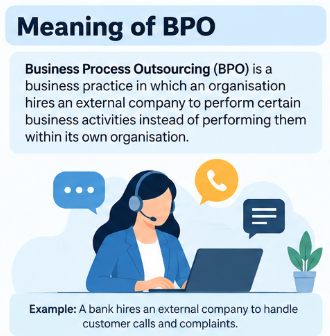
Business Process Outsourcing (BPO) is a business practice in which an organisation hires an external company to perform certain business activities instead of performing them within its own organisation.
In simple words, when a company gives some of its work to another company in exchange for payment, it is called Business Process Outsourcing.
Businesses generally outsource activities that require specialised skills or are time-consuming, such as customer support, accounting, payroll processing and data entry.
Example: A bank hires an external company to handle customer calls, answer queries and register complaints instead of managing all these activities through its own employees.
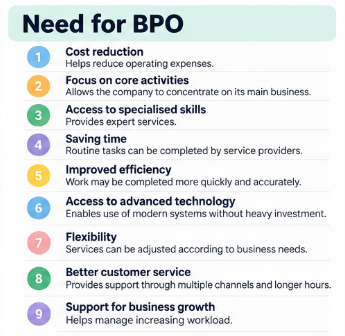
NEED FOR BUSINESS PROCESS OUTSOURCING (BPO)
Businesses need BPO for the following reasons.
1. Reduction in Cost
BPO helps organisations reduce operating expenses. Setting up a separate department requires investment in employees, training, equipment, office space and technology. By outsourcing certain activities, companies may reduce these costs.
Example: A small company hires an external agency to manage payroll instead of employing a separate payroll team.
2. Focus on Core Business Activities
Every business has certain main activities that directly contribute to its objectives. BPO allows companies to concentrate on these activities while external service providers manage supporting functions.
Example: A clothing manufacturer focuses on designing and producing clothes while outsourcing customer support.
3. Access to Specialised Skills
BPO companies often employ trained professionals who have expertise in particular business processes. Outsourcing enables organisations to use these skills without developing the same expertise internally.
Example: A company hires an IT service provider to maintain its computer systems.
4. Saving Time
Some business activities require considerable time and effort. Outsourcing these activities allows the company’s management and employees to devote more time to important tasks.
Example: A business outsources data entry so that its employees can concentrate on sales and customer relationships.
5. Improvement in Efficiency
Specialised service providers may have better systems, trained employees and established procedures. These can help complete tasks more efficiently and accurately.
Example: An external accounting company uses specialised software to maintain financial records.
6. Access to Advanced Technology
BPO providers may already have modern software, equipment and technological systems. Companies can benefit from these resources without making large investments in technology.
Example: A business hires an external IT company to provide technical support and maintain its software.
7. Flexibility in Business Operations
Business requirements may change according to seasons, customer demand and market conditions. BPO allows organisations to increase or decrease certain outsourced services according to their needs.
Example: An online shopping company hires additional customer support services during a festival sale.
8. Improvement in Customer Service
BPO providers can help businesses offer customer support through telephone, email, live chat and other communication channels. Some providers also offer support beyond normal business hours.
Example: A telecom company outsources its customer helpline to provide assistance to customers throughout the day.
9. Better Use of Resources
Outsourcing allows businesses to use their money, employees and other resources more effectively. Resources can be directed towards activities that are more important for business growth.
Example: A company outsources routine administrative work and uses its employees for product development and marketing.
10. Support for Business Growth
When a company expands, its workload increases. BPO providers can help manage additional work without requiring the company to establish every department internally.
Example: A growing e-commerce business outsources order processing to manage an increasing number of orders.
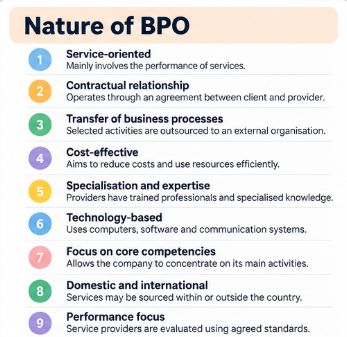
NATURE OF BUSINESS PROCESS OUTSOURCING (BPO)
The nature of BPO refers to its main characteristics and features.
1. Service-Oriented Activity
BPO mainly involves the performance of services for another organisation. These services may include customer support, accounting, payroll processing and IT assistance.
Example: A BPO company provides customer care services to a bank.
2. Contractual Relationship
BPO generally operates through an agreement between the client company and the service provider. The agreement specifies the services to be provided, payment terms, responsibilities and expected performance standards.
Example: A company signs a contract with a BPO provider to manage its customer support for one year.
3. Transfer of Business Processes
In BPO, an organisation transfers the responsibility for selected business activities to an external service provider. The company does not necessarily transfer its entire business.
Example: A company outsources its payroll processing but continues to manage its own production and sales.
4. Cost-Effective Approach
BPO aims to help organisations manage expenses and use resources efficiently. However, actual savings depend on the service provider’s charges, contract terms and quality of services.
Example: A small business outsources bookkeeping instead of maintaining a separate accounting department.
5. Specialisation and Expertise
BPO providers often specialise in particular activities and develop expertise through experience, training and technology.
Example: A specialised call centre handles customer enquiries for several businesses.
6. Technology-Based Operations
Modern BPO activities depend heavily on computers, the internet, communication systems and specialised software. Technology helps service providers manage information and communicate with clients.
Example: A BPO company uses customer relationship management software to record customer complaints.
7. Focus on Core Competencies
BPO allows organisations to concentrate on their core competencies, meaning the activities they perform particularly well or that are central to their business success.
Example: A software company focuses on software development while outsourcing its office cleaning and payroll activities.
8. Domestic and International Operations
BPO services may be obtained from a service provider within the same country or from another country.
- Domestic BPO: Work is outsourced within the same country.
- Offshore BPO: Work is outsourced to a company in another country.
- Nearshore BPO: Work is outsourced to a nearby country.
Example: An Indian company hiring another Indian company is domestic outsourcing, while a US company hiring an Indian service provider is offshore outsourcing.
9. Performance and Quality Focus
BPO services are often evaluated using performance measures such as accuracy, response time, productivity, cost and customer satisfaction. Service providers are expected to meet the standards agreed upon with the client.
Example: A customer support provider may be evaluated on how quickly and accurately it resolves customer complaints.
10. Sharing of Responsibilities
In BPO, the client company and the service provider have different responsibilities. The service provider performs the agreed activities, while the client company generally monitors performance and ensures that the outsourced work supports its business objectives.
Example: A bank outsources customer calls but remains responsible for its banking services and customer relationships.
11. Risk of Dependence on External Providers
BPO creates some dependence on the service provider. Delays, poor service quality, communication problems or data security issues may affect the client company’s operations.
Example: If an outsourced customer support centre experiences a technical failure, customers may not receive timely assistance.
12. Continuous Improvement
BPO providers may regularly improve their processes through employee training, updated technology, automation and performance monitoring.
Example: A BPO company introduces automated systems to handle routine customer queries more quickly.
SCOPE OF BUSINESS PROCESS OUTSOURCING (BPO)
The scope of Business Process Outsourcing (BPO) refers to the various business activities and services that a company can outsource to an external service provider. BPO covers a wide range of activities, from customer support and accounting to human resource management and information technology.
The major areas covered under BPO are explained below.
1. Customer Support Services
Customer support is one of the most common areas of BPO. Companies outsource customer-related activities to specialised service providers.
- Handling customer queries: Answering questions about products and services.
- Complaint management: Resolving customer complaints and problems.
- Call centre services: Handling incoming and outgoing customer calls.
- Technical assistance: Helping customers solve technical problems.
- Email and chat support: Providing assistance through emails, live chats and social media.
Example: A mobile phone company hires a BPO company to handle customer complaints and service-related queries.
2. Accounting and Finance Services
Many organisations outsource their accounting and financial activities to reduce costs and improve accuracy.
- Bookkeeping: Recording daily financial transactions.
- Payroll processing: Calculating employees’ salaries, deductions and payments.
- Accounts payable: Managing payments that a business owes to suppliers.
- Accounts receivable: Managing money that customers owe to the business.
- Invoice processing: Preparing, checking and processing invoices.
- Financial reporting support: Preparing financial records and reports.
Example: A small business hires an external company to maintain its accounts and process employees’ salaries.
3. Human Resource Management (HRM)
BPO also covers various human resource activities. Companies outsource these activities to save time and manage employees more efficiently.
- Recruitment support: Advertising vacancies, screening applications and scheduling interviews.
- Payroll management: Preparing salary statements and processing salary payments.
- Employee record management: Maintaining employee information and documents.
- Training support: Organising employee training programmes.
- Benefits administration: Helping manage employee benefits and related records.
- Attendance management: Maintaining attendance and leave records.
Example: A company hires a BPO provider to screen job applications and maintain employee records.
4. Information Technology (IT) Services
Information technology is an important area of BPO. Companies outsource IT-related activities to obtain technical expertise and reduce the cost of maintaining their own IT departments.
- Technical support: Helping employees and customers solve computer-related problems.
- Software support: Assisting with software installation, maintenance and troubleshooting.
- Network management: Monitoring and supporting computer networks.
- Data management: Organising, storing and maintaining business data.
- Website maintenance: Updating and maintaining company websites.
- Cybersecurity support: Assisting with security monitoring and protection of information.
Example: A company hires an external IT service provider to maintain its computer systems and provide technical support.
5. Data Entry and Data Processing
Data entry and processing involve collecting, entering, organising and updating information. These activities are frequently outsourced because they can be time-consuming.
- Data entry: Entering information into computer systems.
- Data conversion: Converting information from one format into another.
- Data verification: Checking information for errors and accuracy.
- Document management: Organising and maintaining digital documents.
- Database updating: Adding, editing and maintaining records.
- Data processing: Arranging raw data into a useful form.
Example: A hospital hires an external service provider to enter patient information into its computer system.
6. Sales and Marketing Services
Businesses outsource certain sales and marketing activities to reach more customers and improve their promotional efforts.
- Telemarketing: Contacting potential customers through telephone calls.
- Lead generation: Identifying people or businesses that may become customers.
- Digital marketing support: Assisting with online promotional activities.
- Market research: Collecting information about customers, competitors and market trends.
- Customer relationship management: Maintaining customer information and supporting customer relationships.
- Sales support: Helping with order enquiries, follow-ups and sales records.
Example: A company hires a BPO provider to contact potential customers and generate sales leads.
7. Research and Analytical Services
BPO providers may conduct research and analyse information to help businesses make better decisions.
- Market research: Studying customer preferences and market demand.
- Competitor analysis: Collecting information about competitors’ products and strategies.
- Business research: Gathering information about industries and business opportunities.
- Data analysis: Examining data to identify patterns and trends.
- Report preparation: Preparing reports based on collected information.
Example: A company outsources market research to understand customer preferences before launching a new product.
8. Healthcare Services
Healthcare organisations also outsource administrative and information-processing activities to specialised service providers.
- Medical billing: Preparing bills for healthcare services.
- Claims processing: Processing insurance claims related to medical treatment.
- Medical transcription: Converting recorded medical information into written documents.
- Appointment scheduling: Managing patient appointments.
- Medical record management: Organising and maintaining patient records while following privacy requirements.
- Insurance verification: Checking patients’ insurance details.
Example: A hospital hires a BPO company to manage medical billing and insurance claims processing.
9. Banking and Insurance Services
Banks and insurance companies outsource several routine activities to improve operational efficiency and customer service.
- Loan processing support: Checking documents and organising loan applications.
- Customer verification: Supporting customer identity verification procedures.
- Transaction processing: Processing routine financial transactions.
- Insurance claims management: Organising and processing insurance claim documents.
- Policy administration: Maintaining insurance policy records.
- Customer service: Answering questions about accounts, policies and services.
Example: An insurance company outsources document processing and customer support to a specialised BPO provider.
10. Legal Process Outsourcing (LPO)
Legal Process Outsourcing is a specialised form of outsourcing in which legal support activities are assigned to external service providers.
- Legal research: Collecting information about laws and legal cases.
- Document preparation: Preparing and organising legal documents.
- Contract management: Reviewing and maintaining contract records.
- Document review: Examining documents for relevant information.
- Legal transcription: Converting recorded legal proceedings into written form.
Example: A law firm outsources legal research and document organisation to a specialised service provider.
11. E-commerce and Logistics Support
With the growth of online shopping, e-commerce businesses outsource several activities related to online orders and deliveries.
- Order processing: Recording and processing customer orders.
- Inventory management support: Maintaining stock records.
- Order tracking: Updating customers about the status of their orders.
- Returns management: Handling product return requests.
- Delivery coordination: Coordinating with delivery partners.
- Online customer support: Answering questions about products, payments and deliveries.
Example: An online shopping company hires a BPO provider to handle order enquiries and return requests.
12. Education and Administrative Services
Educational institutions and training organisations also outsource certain administrative activities.
- Student support: Answering students’ questions about courses and admissions.
- Admission processing: Managing application forms and admission records.
- Fee management support: Maintaining fee records and payment information.
- Examination support: Assisting with examination registration and related documentation.
- Online learning support: Providing technical assistance to students using online learning platforms.
- Record management: Maintaining student and institutional records.
Example: A university outsources admission enquiry services to an external customer support company.
KNOWLEDGE PROCESS OUTSOURCING
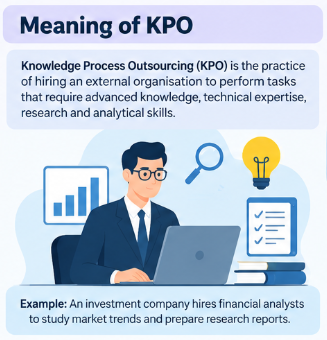
Knowledge Process Outsourcing (KPO) refers to the practice of hiring an external organisation or specialised professionals to perform tasks that require advanced knowledge, technical expertise, research and analytical skills.
In simple words, when a company gives specialised work that requires expert knowledge to another company, it is called KPO.
Examples of KPO
- Financial Analysis: Analysing financial statements and investment opportunities.
- Market Research: Studying market trends, customer preferences and competitors.
- Legal Research: Researching laws and preparing legal documents.
- Data Analytics: Analysing complex data to support business decisions.
- Research and Development: Conducting specialised research to develop new products or improve existing ones.
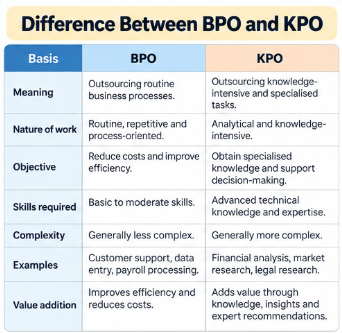
DIFFERENCE BETWEEN BPO AND KPO
BPO (Business Process Outsourcing) refers to outsourcing routine business activities to an external service provider, whereas KPO (Knowledge Process Outsourcing) refers to outsourcing specialised tasks that require advanced knowledge, analytical skills and professional expertise.
| Basis | BPO (Business Process Outsourcing) | KPO (Knowledge Process Outsourcing) |
| 1. Meaning | It involves outsourcing routine business processes to an external organisation. | It involves outsourcing knowledge-intensive and specialised activities to experts. |
| 2. Nature of Work | Work is generally routine, repetitive and process-oriented. | Work is analytical, research-oriented and knowledge-intensive. |
| 3. Objective | To reduce costs, save time and improve operational efficiency. | To obtain specialised knowledge, conduct research and support decision-making. |
| 4. Skills Required | Basic to moderate skills and process-specific training are generally required. | Advanced technical knowledge, analytical abilities and professional expertise are generally required. |
| 5. Complexity | The work is generally less complex and follows established procedures. | The work is generally more complex and requires judgement and critical thinking. |
| 6. Decision-Making | Usually involves following predefined rules and procedures. | Often involves analysis, interpretation and recommendations for decision-making. |
| 7. Employees | Employees are generally trained to perform specific business processes. | Employees often have specialised qualifications and expertise in their fields. |
| 8. Cost | The cost per task is generally lower. | The cost is generally higher because of specialised expertise. |
| 9. Examples | Customer support, data entry, payroll processing and call centre services. | Market research, financial analysis, investment research and business analytics. |
| 10. Value Addition | It mainly improves efficiency and reduces operational costs. | It adds value through knowledge, insights, research and expert recommendations. |
CONCLUSION
BPO mainly focuses on performing business processes efficiently, whereas KPO focuses on using specialised knowledge and analytical skills to solve complex problems and support business decisions.